

By Richard Wood
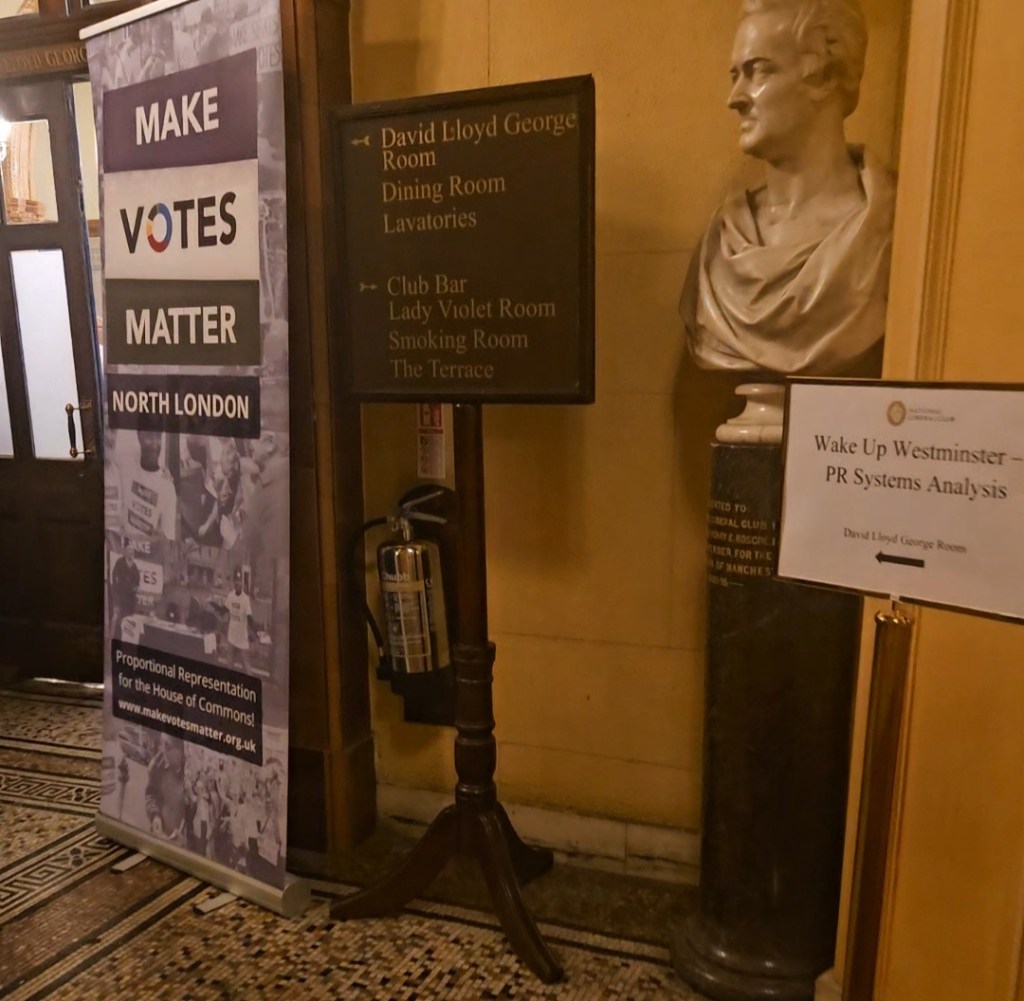
At an event in London’s National Liberal Club on Monday 8 June 2026, the proportional representation campaign organisation Make Votes Matter launched a report outlining the cases for different voting systems.
Make Votes Matter has largely focused on making the principled case for PR rather than advocating for a particular alternative to First Past the Post.
And back in 2019, they outlined the ‘Good Systems Agreement’, highlighting 10 key principles which underpin a good voting system, crucially focused on seats matching votes.
This agreement achieved widespread publicity after the Brexit Party (now Reform) signed the agreement in addition to the Liberal Democrats, SNP, Plaid Cymru, the Greens, and politicians and public figures from across the political spectrum.
The new report ‘What Could Future Electoral Systems Look Like?‘ takes this a step further outlining four voting systems, which could (if designed well) be welcome proportional alternatives to First Past the Post.
READ MORE: 12 reasons why the UK needs Proportional Representation now
4 alternatives to First Past the Post in Westminster
The report very clearly takes the ten principles of the Good Systems Agreement and uses that as the foundations on which to build practical electoral systems that could replace FPTP.
The four systems identified are: the Additional Member System, the Single Transferable Vote, regional list PR, and, perhaps surprisingly, the Alternative Vote Plus, which was recommend by the Jenkins’ committee in the early days of the previous Labour government.
The report doesn’t outline these systems in detail. Rather it highlights examples where these systems have worked well and where they haven’t, and sets out several recommendations of how each system should operate to meet the ten criteria identified in the Good Systems Agreement. Some of the particulars can be quibbled over, but by and large the recommendations are welcome and far superior to First Past the Post. This is a major step towards narrowing the options for an alternative.
READ MORE: First Past the Post will let down Scotland yet again, polling suggests
What does Make Votes Matter’s report say about Scotland?
The report focuses on Westminster, highlighting the Additional Member System in Holyrood as one of several viable alternative to Westminster’s indefensible First Past the Post system.
One weakness of the report, from the Scottish perspective, is that it only covers Scottish elections up to 2021, all six of which were broadly proportional. The report doesn’t highlight how AMS delivered a disproportional result in 2026 due to the dominance of First Past the Post exposed by changing voting patterns and party choices. This is likely due to publication deadlines (what with the election only being a month ago), but is something to consider in future considerations concerning adopting a mixed-member system for Westminster.
Here, it’s also worth highlighting that former Lib Dem president turned member of the House of Lords Mark Pack, who was on the panel for the report launch, remarked upon the recent election and the high levels of split ticket voting in part caused by the Scottish Greens not standing on the vast majority of Scottish seats.
A system modelled on Holyrood’s would be a major improvement to First Past the Post, but the lessons of 2026 must be considered when the time comes to overhaul Westminster democracy for the better.
More about the report launch can be viewed here.
READ MORE: Holyrood needs electoral reform: 2026 was Scotland’s least representative election

