


Plaid Cymru’s 2026 manifesto commits to upgrading Wales’ voting system

By Richard Wood

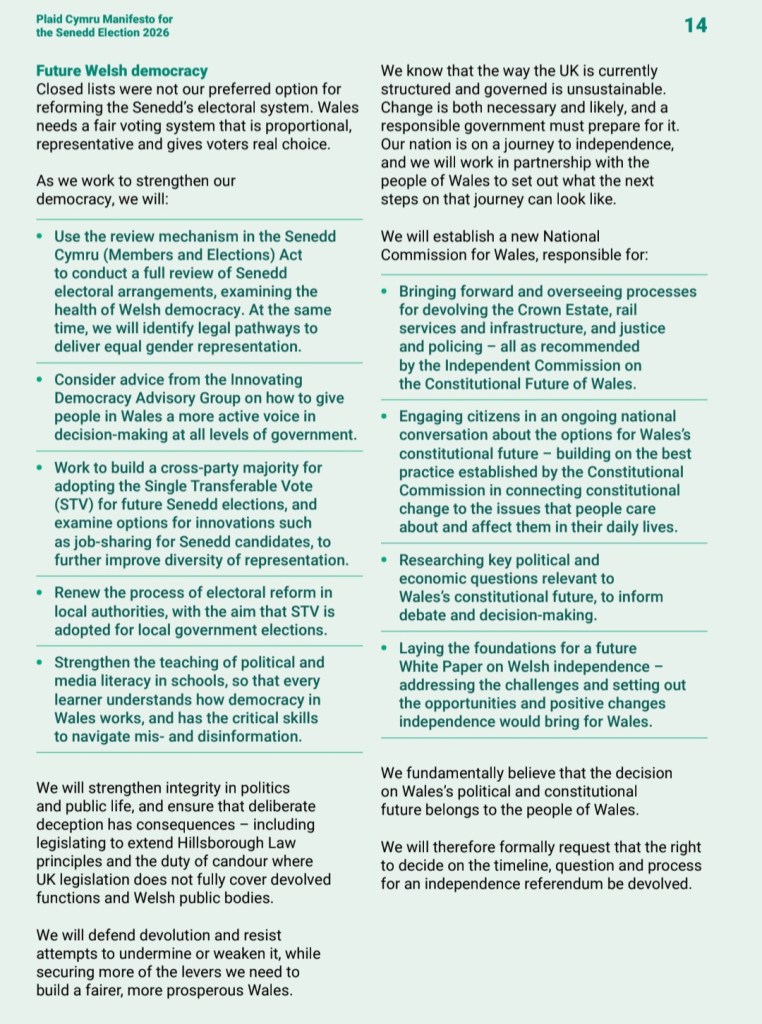
Plaid Cymru’s manifesto for the 2026 election makes the case to reform the Senedd’s recently changed electoral system.

During the last Senedd session Welsh Labour and Plaid Cymru came together to reform Wales’ Additional Member System (AMS). AMS has ensured an element of proportionality in elections since 1999 but the dominance of constituency (much more so than in Scotland) has delivered only somewhat proportional elections.

The 2026 election is being held under a closed list proportional system with 16 multi-member constituencies, each electing 6 MSs.

Abolishing the First Past the Post element by replacing AMS was a welcome step forward, but closed list voting puts an incredible amount of power in the hands of parties. Moving towards the Single Transferable Vote or and open list system would address these concerns.

What does Plaid Cymru’s manifesto say on electoral reform?

Plaid Cymru’s manifesto notes that closed lists were not their preferred option for change.

They also call for a system that delivers real choice, ultimately backing STV for the Senedd and Welsh local government.

This is a positive step to improve proportionality, representation and voter choice at elections. However, if they do succeed in changing the system so soon they do run the risk of frustrating voters by changing things yet again. Their call to build consensus in the issue therefore matters considerably.
READ MORE: SNP could win unrepresentative majority on 29% of the vote, suggests MRP poll

What is Welsh polling saying?

Recent polls in Wales suggest Plaid Cymru could become the largest party in the Senedd, a significant change from Labour’s dominance since 1999 and at UK General Elections for a century.

Reform are biting at their heels for first place while the Greens hope to win their first MSs.

Meanwhile, polls suggest the Labour and Conservative votes are collapsing.

While the Lib Dems are hoping to keep their sole seat and gain another if possible.

READ MORE: Scotland’s STV council elections show England a better way of doing local democracy

Scotland must follow Wales on four-year terms

By Richard Wood

On 18 September 2023, Mick Antoniw MS, Counsel General and Minister for the Constitution, laid the Senedd Cymru (Members and Elections) Bill before the Senedd. The Bill outlines a series of reforms, as part of the Welsh Labour and Plaid Cyrmu cooperation agreement, the Welsh democracy.

The headline changes are the switch from the Additional Member System (AMS) to a Closed List Proportional voting system and an increase to 96 Members of the Senedd.

One important change which hasn’t received much attention is a return to four-year terms. This means that, if the Bill becomes law, after the planned 2026 election the next Welsh election will be 2030 – not 2031.

READ MORE: How proportional are Scottish, Welsh and Northern Irish elections?

This switch to four-year terms will improve accountability and strengthen the link between voters and their representatives. There’s no right answer as to how often elections should be, but five-year terms lead to zombie governments (just look at Westminster right now) and limited accountability. They also mean voters going to the polls just twice a decade. Two-year terms on the other hand lead to constant electioneering as seen in the states. And there’s definitely an element of this in Australia and New Zealand, which have three year terms, as well as limited ability to take long-term actions. Four-year terms however, strike a sensible balance between accountability and stable governance. The Welsh Government’s reform is the right move.

READ MORE: Time is running out for fair local government in Wales

Unfortunately, like Wales, Scotland moved to five-year terms in the Scottish Elections (Reform) Act in 2020 to accommodate the UK’s now repealed Fixed-Term Parliaments Act. The next planned election after 2026 will be 2031, one year after Wales’ next vote after 2026. There’s nothing wrong with devolved elections being out of sync but the accountability deficit in Scotland will be larger than in Wales. Holyrood can do better. To empower voters, and hold MSPs to account, that should change.

The Scottish Parliament needs a democratic upgrade – Holyrood should follow the Senedd and return to four-year terms. Parties should consider this ahead of the 2026 election.

READ MORE: 7 reforms to improve the Scottish Parliament

Image via Pixabay