The 2024 UK General Election has exposed the flaws of Westminster’s First Past the Post once again.
The 4 July vote shows just how much the voting system used to elect MPs distorts how people vote at the ballot box. While Labour did well, Keir Starmer’s party won 63% of seats on just 34% of the vote.
This is a staggering mismatch between seats and votes, exposing the absurd unfairness of our electoral system once again.
Meanwhile, Reform secured 14% of the vote. Under a proportional voting system they would have roughly 14% seats but in the end they only scraped five seats. Similarly, the Greens only managed four seats on 7% of the vote.
The Lib Dems won 72 seats (11% of those available) on 12% vote, by coincidence broadly in line with their share of the vote. While the Conservatives – champions of our regressive system – suffered at its hands by winning 19% of seats on 24% of the vote.
The election has been called the most unrepresentative in British political history. In fact, the Gallagher index (a measure of electoral proportionality) was 24 (the highest ever in a UK election), backing these claims.
Some discussion of the Gallagher Index in the last few days, but the alternative Sainte-Laguë index paints an even worse picture – giving a disproportionality score of 48.8, a solid 49% more skewed than the second least proportional election (2015). pic.twitter.com/yoUHGrIEls
Of course, anti-Consevative tactical voting likely widened the disparity between seats and votes – with Lib Dem votes piling up in areas they could win and Labour in areas they could take. But that’s no excuse for the reality where we have a system in which, forgetting all motivations for why people vote a particular way, the total number of votes per party doesn’t result in result in matching seat shares. Tactical voting is a symptom of First Past the Post, showing the need for electoral reform. And at the end of the day, people deserve to vote for their favoured candidates without the fear that their vote won’t count. You should be able to vote for something, rather than forced into voting against something else.
First Past the Post has once again been exposed as a failed system. But with this comes opportunity for change.
While Labour’s leadership oppose a change in voting system, the massive mismatch is cutting through to citizens. There’s an opportunity here to stress this mismatch and make the case for Proportional Representation and continue the fight for reform.
It’s time to redouble our efforts to secure electoral reform. It’s time for Proportional Representation.
Leader of the Scottish Labour Party Anas Sarwar has called for Scottish metro mayors in a speech marking 25 years of devolution.
The remarks follow his party winning all but one metro mayoral seats up for election south of the border this May, the most notable of which was Richard Parker’s win against incumbent Conservative Mayor Andy Street.
The main appeal of metro mayors is their ability to champion the areas they represent on scale not quite seen by constituency MPs. There’s little denying that Andy Burnham is able to grab media and government attention in a unique way suited to our current news and political landscape. Not to mention that to many voters elected mayors are seen as more accountable than a largely unnoticed council cabinet committee.
Furthermore, a metro mayor equivalent for Dundee for example could give different parts of Scotland the political attention they deserve, shifting focus away from the central belt.
However, metro mayors are far from a panacea. Despite the profile brought by the likes of Andy Burnham and Sadiq Khan, the elections that put them in power are characterised by low turnout.
On top of that, elected mayors mark a shift away from deriving local government executives from elected councils. Concentrating such powers in one individuals would be a major jump from the culture of consensus set out with the set-up of the Scottish Parliament and shift to STV for local authorities, pushing Scotland in a more majoritarian direction.
Additionally, Scottish local government has far bigger problems such as funding and structural issues that imposing elected mayors or provosts won’t fix.
Any discussion about moving to a metro mayor system must be open, honest and frank. Crucially, three tests must be met if Scotland were to go down the path of introducing metro mayors.
Elected mayors put a significant amount of power in the hands of one individual. Yes, they have a team that do much of the day to day work but ultimately directly elected executive mayors arguably give mayors too much power. A simple truth about democracy is that despite best intentions, one individual cannot fairly represent the views of all their constituents. Any elected mayors would need to be accountable to voters at elections and to elected councils – proportionately elected and with real powers of scrutiny – throughout their term.
2. Preferential voting
The UK government’s Election Act changed the voting system for directly elected executive mayors from the Supplementary Vote to First Past the Post. The Supplementary Vote was far from perfect but it at least gave a broader mandate to elected mayors as opposed to FPTP. If Scotland follows England, we should learn from the mistakes of the Elections Act and use the Alternative Vote to elect mayors. A preferential voting system would empower voters and give mayors the broad mandates they need to lead.
3. Referendum
Lastly, directly elected executive mayors should not be imposed on a populace without consent, whether that be by any new Scottish Government or local authorities themselves. Any proposals should be subject to a significant consultation process and conclude with a referendum to determine whether they are the right decision for each community. Likewise, communities should be able to vote to revert to a cabinet system for local government if they choose.
The adoption of directly elected executive Scottish mayors is an intriguing prospect but it would have significant downsides, notably the concentration of executive power in one pair of hands and a major shift away from the consensus-building democracy that has characterised Scotland in the age of devolution.
There are of course potential benefits as seen in England but any concrete proposals for reform should be carefully examined and criticised where appropriate.
If Scottish Labour, or any other party, do ever introduce elected mayors then their implementation must pass the three tests outlined above. However, lawmakers should in the first instance focus on more pressing issues facing local authorities as opposed to looking south for flashy reforms that aren’t necessarily what they seem. Anas Sarwar should consider all this if introducing metro mayors is ever something he gets the powers to do.
The appointment of David Cameron to UK foreign secretary via appointment to the House of Lords raises an interesting question about the relationship between the executive and the legislature. Primarily at Westminster but also at Holyrood.
The big issue in Westminster is the absurdity of the (by convention) only route for people to become ministers who aren’t MPs is through being appointed to the House of Lords. For life. There’s then the issue that these ministers can’t appear before MPs to be held to account. The situation is frankly absurd and in need of reform. Rishi Sunak’s appointment puts a spotlight on this bizarre route to government. If we are to allow people who aren’t legislators to join the executive – and there’s a strong case to allow that to be the case in line with plenty of other democrscies around the world – then we need to fix this bizarre Westminster process.
So, what’s the situation in Scotland? Currently, only MSPs can become cabinet secretaries in the Scottish Government. It’s right that most ministers come from the elected Scottish Parliament but with just 129 MSPs, there is a good case for enabling cabinet secretaries to be appointed from outside the legislature. Such a rule would strengthen the diversity of talent within the Scottish Government. But any rule should have democratic accountability.
Crucially, if we are to go down this road then MSPs appointed to cabinet should be approved by the Scottish Parliament. This would be a similar nominations and vote process to that of the Cabinet of the United States and other democracies, ensuring that such cabinet secretaries are accountable to parliament.
Furthermore, that accountability should be strengthened by enabling such cabinet secretaries to make statements and answer questions in parliament. MSPs should be able to directly question any and all cabinet secretaries, including those chosen from outside parliament.
There could even be a limit on the number of people non-MSP cabinet secretaries appointed to ensure that the majority of cabinet members come from the legislature, if that’s a concern.
This is hardly the most pressing reform that could improve Scottish democracy – Holyrood needs better Proportional Representation, fixed four-year terms and restrictions on second jobs and dual mandates – but reform in this area is worth considering in light of former Prime Minister David Cameron’s appointment to the role of UK Foreign Secretary.
The alliance includes all the UK’s main opposition parties, leading democracy organisations (apart from Labour) and key PR supports from right across the UK. Make Votes Matter’s goal is to replace First Past the Post with Proportional Representation for elections to the House of Commons.
Upgrade Holyrood primarily supports better democracy in Scotland – by arguing for an end to dual mandates, the introduction of a recall process for MSPs and better Proportional Representation at Holyrood. But Upgrade Holyrood also passionately supports the introduction of PR at Westminster.
“Adopting a system of Proportional Representation is the single-most important improvement we can make to democracy in the UK. We need to correct the distorted link between seats and votes so that voters are accurately represented and wasted votes are minimised.”
“The voting system used to elect Members of the Scottish Parliament has its flaws but it does deliver largely proportional results and is far more representative First Past the Post. Westminster has a lot to learn from the way Scottish Parliament elections are conducted.
“Without Proportional Representation at Holyrood, the SNP would unfairly dominate parliament due to their near monopoly of constituency seats. Scottish Labour and the Scottish Conservatives would have next to no representation, not to mention that both Anas Sarwar and Douglas Ross owe their admittance to the Scottish Parliament to PR.”
“Westminster needs a major shake-up and I am proud that Upgrade Holyrood has joined the Alliance for Proportional Representation to help make that happen.”
_______________________________
More about Make Votes Matter’s Proportional Representation Alliance can be read here.
On Monday 13 September, Norwegians elected their new parliament (called the Storting).
The big stories of the night were the success of the left and centre parties, Conservative Prime Minister Erna Solberg admitting defeat, and the fall in support of the controversial right-wing populist Progress party.
The election may not have hit the headlines across democratic world in the same way as the upcoming Canadian and German elections, but it has been a significant election for Norway – ending 8 years of right-of-centre governance.
But what voting system does Norway use? And how proportional was its recent election and what lessons can we learn in the UK?
Norway's left-wing opposition headed by Labour Party leader Jonas Gahr Store won Monday's general election after a campaign dominated by questions about the future of the key oil industry in Western Europe's largest producer. https://t.co/4aszMDYXHB
Unlike the UK, Norway uses a form of Proportional Representation (PR) to elect its parliaments. This means that, unlike at Westminster, how people vote at the ballot box is accurately reflected in the parliament. Without a form of PR to elect representatives, unlike Norway’s Storting, the House of Commons is semi-representative at best.
At the last UK election, the Conservatives got 43.6% of the vote but thanks to the UK’s First Past the Post system, they won 56% of seats in the House of Commons. Meanwhile, the Lib Dems won 11.6% of the vote but only 3% of seats available while the Green Party of England and Wales won 2.7% of the vote but only one seat.
The UK’s voting system clearly distorts the link between seats and votes, unfairly advantaging larger parties and wasting countless votes.
The vast majority of OECD countries use some form of Proportional Representation to elect their MPs and Norway is one of them.
Norway uses a form of Open List PR with a 4% threshold to elect 169 MPs across 19 constituencies. This includes levelling seats to further ensure national party proportionality. Voters also have a say over the ordering of party lists in their constituency for the party they vote for, empowering voters more than in a Closed List PR system (such as the one previously used for UK elections to the EU parliament where lists were inflexible) or First Past the Post.
More about the voting system can be read on the Electoral Reform Society’s site here.
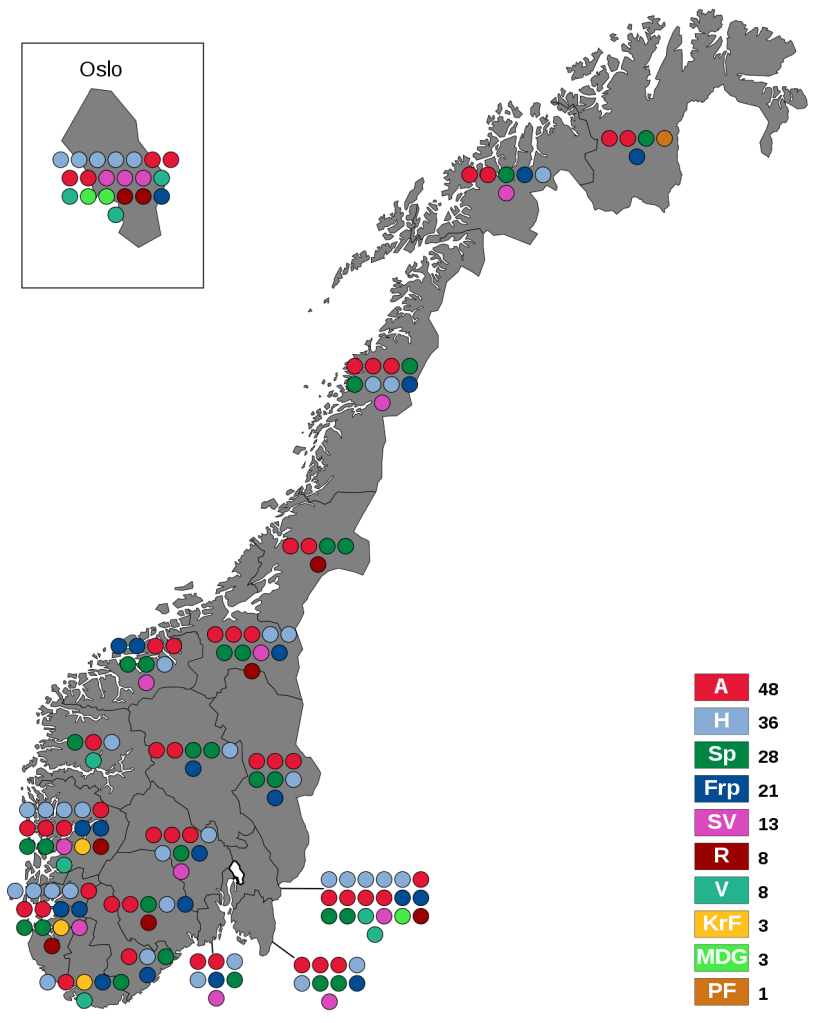
Norway’s 2021 election results
The country’s voting system ensures that seats broadly match votes. The full results for the 2021 election are show below.
Labour: 26.4% of the vote (48 seats), 28.4% of seats)
Conservatives: 20.5% votes (36 seats), 21.3% of seats
Centre: 13.6% of the vote (28 seats), 16.6% of seats
Progress: 11.7% of the vote (21 seats), 12.4% of seats
Socialist Left: 7.5% of the vote (13 seats), 7.7% of seats
Red: 4.7% of the vote (8 seats), 4.7% of seats
Liberal: 4.5% of the vote (8 seats), 4.7% of seats
Green: 3.8% of the vote (3 seats), 1.8% of seats
Christian Democrat: 3.8% of the vote (3 seats), 1.8% of seats
Patient Focus: 0.2% of the vote (1 seat), 0.6% of seats
On the back of these results, Conservative Prime Minister Erna Solberg admitted defeat and it now looks likely that a left of centre government will be formed – led by the Labour Party. Analysis suggests that complex coalition talks are expected to follow the vote.
Put simply, Norway’s latest election results were very proportional. The proportion of seats won by each party strongly correlates with the proportion of votes cast for each party as shown by the above results. This is in stark contrast with UK election results such as the 2005 election where Labour won a majority on just 35% of the vote or the 2015 election where UKIP won just 1 seat on 13% of the vote.
Overall, there is a strong link between seats and votes at Norwegian elections. However, it is worth caveating that seats are distributed so that rural areas have slightly more representation per person than urban counterparts, slightly skewing the link between seats and votes.
Furthermore, although thresholds are common in PR systems, the 4% threshold in Norway means that elections are not purely proportional – this may be reduced to 3% in the coming years. This is for information purposes and the merits of thresholds in such systems can be debated elsewhere as the purpose of this article is to highlight how much more representative a PR system is than FPTP. For more about the ins and outs of Norway’s election system, please read the Electoral Reform Society article on PR in Norway.
After eight years of a Conservative-led government, Norway has voted for a change. The Labour Party may have lost seats in this election but PR means that government formation is not about who is the biggest party. Instead Nowegian parliaments accurately represent how people vote with governments formed by whichever coalition of parties can command a majority in the Storting. In this case, the governing right-of-centre parties lost seats overall while the left and centre made gains. All in all, the distribution of seats fairly reflects votes cast at the ballot box.
Norwegian elections are highly proportional and have limited wasted votes. Norwegian votes matter – all thanks to Proportional Representation.
Westminster should learn from countries such as Norway and adopt Proportional Representation to upgrade UK democracy.
Upgrade Holyrood is a Scottish politics site dedicated to improving Scottish democracy while at the same time being an advocate for PR and other democratic improvements at the UK-level.
Germany’s SPD Chancellor-candidate Olaf Scholz (Pixabay)
Upgrade Holyrood’s Richard Wood has written a new article for Politics.co.uk (published 9 September 2021), highlighting the upcoming German and Canadian elections and the need for Proportional Representation in the UK.
Two leading democracies go to the polls later this month, both facing far from certain outcomes. The end of the Merkel era places Germany at a crossroads with a diverse range of multi-party coalitions on the table. Meanwhile, Canada’s election is Justin Trudeau’s gamble to turn his minority government into a majority one, despite polls suggesting this could backfire and hand power to the country’s Conservatives.
Held within a week of each other, these elections are two very different interpretations of democracy due to their contrasting electoral systems. They show how the UK has two possible futures ahead. The Canadian route, based around First Past the Post (FPTP), typifies just a semi-representative democracy. And the German route, based around Proportional Representation (PR),which ensures an accurate link between votes cast and seats won.