
By Richard Wood
The Scottish Labour leader Anas Sarwar published his party’s manifesto for the 2026 election on Monday 13 April 2026. Here’s what the party has pledged to do if it defies the odds and is returned to power after nineteen years in opposition at Holyrood.
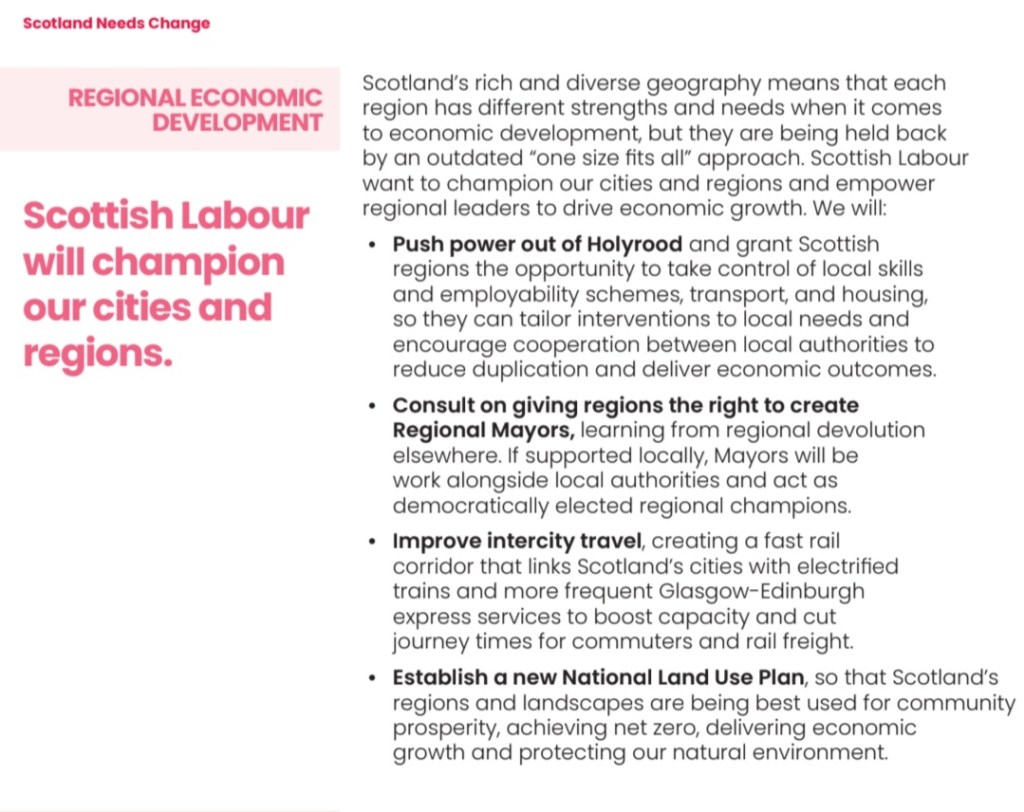
Scottish Labour want regional mayors for regions that want them
The manifesto commits the party to consulting on regional mayors, learning from blueprints in England. This isn’t a surprise and has been floated by Anas Sarwar previously. Crucially, the party only supports mayors if there is local support.
Regional mayors sound like an answer to re-energise local democracy in Scotland by having one single figure of accountability who can champion local interests. But regional mayors risk putting a lot of power into one person’s hands while also limiting multi-party politics at a time where people have a wide range of views on issues. Any proposals for such mayors should be carefully considered, as representative as possible and actively supported by local people. They’re not necessarily right for Scotland, but if they do ever go ahead they must be robust as possible with strong safeguards to ensure multi-party representation and real voter power over them.
READ MORE: 3 tests Anas Sarwar’s Scottish metro mayor plans must meet

Anas Sarwar hopes to decentrentralise power away from Holyrood
The other plank of Scottish Labour’s limited democracy plans for Scotland is to “push decision making power out of Holyrood so local people have more of a say over public services” as part of a Local Democracy Act.
They pledge to: “Push power out of Holyrood and grant Scottish regions the opportunity to take control of local skills and employability schemes, transport, and housingso they can tailor interventions to ocal needs andencourage cooperation between local authorities toreduce duplication and deliver economic outcomes.”
There’s also an interesting idea to force statutory consultations when local councils plan to cut local services such as libraries.
READ MORE: Will the Scottish Parliament change its voting system?
Ambitious plans to enhance accountability at Holyrood: second job rules and empowering committees
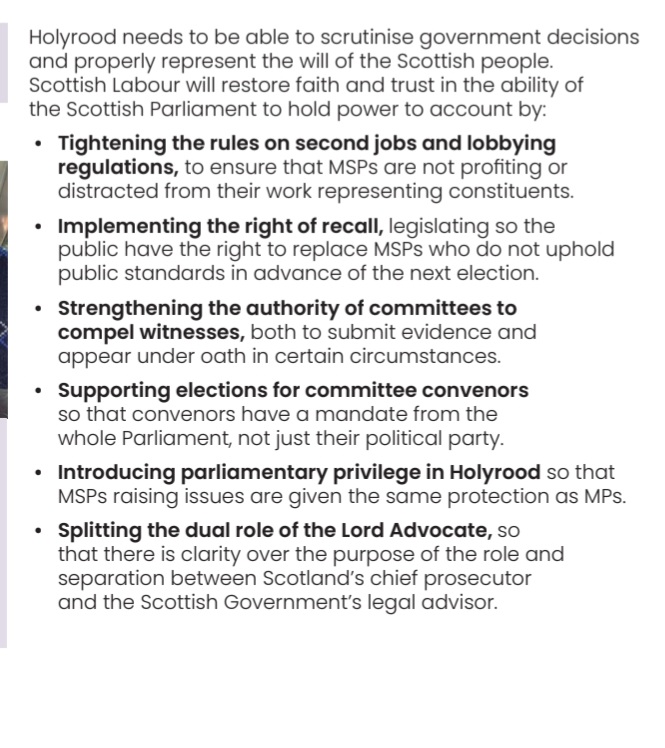
After a worrying manifesto from Reform on the democracy front and lacklustre democracy reform proposals from the Scottish Conservatives, Scottish Labour have some welcome ideas to improve accountability in the Scottish Parliament.
This includes welcome regulation over on second jobs for MSPs and lobbying.
There’s also a proposal to introduce a right to recall MSPs who don’t live up to public standards, which is welcome to see after proposals faltered in the last parliament.
Scottish Labour also want to strengthen committees by giving them teeth to compel witnesses and by electing committee convenors, which is due to happen regardless.
The proposal to provide parliamentary privilege to MSPs is also welcome to strengthen the legitimacy of MSPs on a par with MPs who already have that right.
And lastly, there’s another welcome pledge to split the role of the Lord Advocate to separate the responsibilities of Scotland’s chief prosecutor and the Scottish Government’s legal advisor, a proposal that’s long over due.
READ MORE: SNP could win unrepresentative majority on 29% of the vote, suggests MRP poll
What about voting system reform?
The manifesto makes no mention of improving Scotland’s Additional Member System which could well deliver Scotland’s least representative election since 1999.
Disappointingly, there’s also no commitment to revert to four-year fixed terms so voters have a more regular say on who represents them.
Have the SNP, the Scottish Lib Dems and other parties published their manifestos?
Reform UK launched their Scottish manifesto first, publishing their document at the end of March.
While the Russell Findlay’s Scottish Conservatives published theirs on Tuesday 7 April, a month before the vote.
The SNP, Scottish Greens and Liberal Democrats are yet to publish their own policies ahead of the vote.
The full Scottish Labour manifesto can be read here.
Images taken from Scottish Labour election manifesto 2026.
READ MORE: Reform UK’s manifesto: Malcolm Offord’s party on Scottish democracy
READ MORE: The Scottish Conservative manifesto is here: what does it say on democracy?