
By Richard Wood
The 2026 Scottish Parliament election has exposed considerable flaws in Scotland’s voting system.
The Additional Member System delivers significantly more representative parliaments than First Past the Post in Westminster, but it is not without its problems.
1. The dominance of First Past the Post means seats aren’t matching votes
Seats have broadly matched votes in each Scottish election since 1999. This hasn’t been perfect, but the 2026 election was objectively the least proportional Scottish Parliament election in the devolution era. The SNP secured 58 seats (45%) on 28% of the list vote, which is meant to determine the proportionality of the parliament overall, and 38% of the constituency vote. In fact, if the system worked as designed the SNP would have won 18 fewer seats than they actually did.
This outcome is a result of changing voter behaviour exposing a deep structural flaw of the system. Simply put, as there are more constituency seats (73) than list seats (56), First Past the Post is in the driving seats and list seats can only go so far to correct any disproportionality caused on the constituency vote. In 2026, the SNP’s vote shares dropped but they benefitted from a divided unionist opposition and the lack of Scottish Green candidates in most seats. The party won 57 of the 73 constituency seats but the fixed number of list seats could only do so much to limit the damage caused by their overperformance.
It goes without saying that this is a major problem no matter which parties benefit and lose from the system. Maybe you’re glad the SNP won more seats than they’d be entitled to under a more proportional system. But consider that if the system doesn’t change a party like Reform could one day benefit from this set-up. The problem here is the system, not the parties in play.
2. Voters have very limited power over individual candidates
Scotland’s voting system puts an incredible amount of power in the hands of political parties. List orders are determined by party members or party bosses (the latter being more democratic) but when it comes to voting, most voters don’t know who’s on the list. In fact, it’s rarely ever listed on the ballot itself. There’s a major lack of transparency in this arrangement.
But the problem goes further than that. Voters can’t change the order of lists. And not only that, constituency votes are effectively party lists of one. Closed regional lists, without the power for voters to rank candidates in order of preference for example, or similar, are detrimental to the empowerment of voters democracy requires.
3. Not everyone is representated by parties they voted for
This is one flaw not talked about enough but it speaks to heart of representative democracy – representation.
Single-member constituencies under First Past the Post aren’t great because the electoral output does not fully capture the diversity of opinion at the ballot box in each constituency. List seats address some of this issue but there’s are still many many voters who don’t have an MSP that aligns with their views.
Consider this: everyone in Scotland is represented by at least one Labour MSP, at least one Reform UK MSP and at least one Scottish Green MSP. That’s because those parties won list seats in every region. In contrast, while most people are representated by SNP MSPs due to constituency wins, the Highlands and Islands is the only region where everyone is represented by the SNP.
Let’s look at a few examples. The Scottish Lib Dem leader Alex Cole-Hamilton won 57.2% of the vote in Edinburgh Northern. Yet almost 1 in 4 voters in his constituency backed the SNP. Because of First Past the Post, and because of the SNP being so dominant in First Past the Post seats, those almost 10,000 voters who supported the SNP’s Lyn Jardine do not have a direct line to a member of a party they voted for in the constituency ballot. Of course, many of those voters gave their list vote to other parties, but there’s clearly a contingent supporters who stayed with the SNP on the list ballot and are without representation.
There’s a similar story in Dumbarton where almost 11,000 voters backed the SNP and other constituencies didn’t win.
In seven constituencies across Scotland, there are voters not represented by Scotland’s largest party.
Again, it doesn’t matter what parties are being discussed. This would be unrepresentative no matter what parties are involved, it just so happens that in this case the system has boosted the SNP but deprived many of their voter without an MSP they voted for.
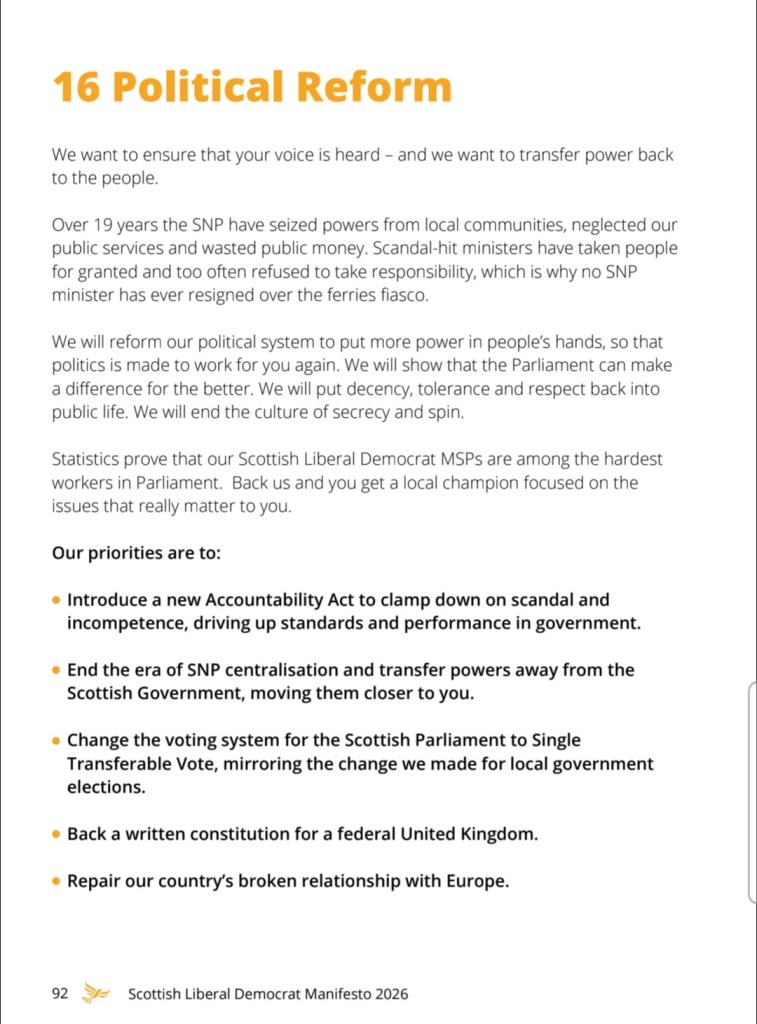
Scotland needs electoral reform
Wales has changed its voting system. It’s not perfect but it has improved proportionality and at least there’s been a process of reform. Scotland should too.
Any new system, or tweaks to the status-quo should address these three flaws. Holyrood needs improved proportionality, better voter empowerment and transparency, as well as fair representation.