
Scottish Green democracy pledges announced in 2026 manifesto

By Richard Wood

The Scottish Greens launched their manifesto on Tuesday 14 April, just shy of three weeks before the election in May. The party are hoping for their best ever Holyrood election result and made those intentions clear at their launch in Glasgow.

My first thought looking at the manifesto was how the title stands out as being very familiar. If you’ve had the same thought it’s because it’s rather reminiscent of a previous Liberal Democrat slogan “demand better”.

The Scottish Lib Dem manifesto is due on Friday while the SNP are expected to publish theirs on Thursday.

This follows Reform, the Scottish Conservatives and Scottish Labour who have all published their plans.

Independence and democracy

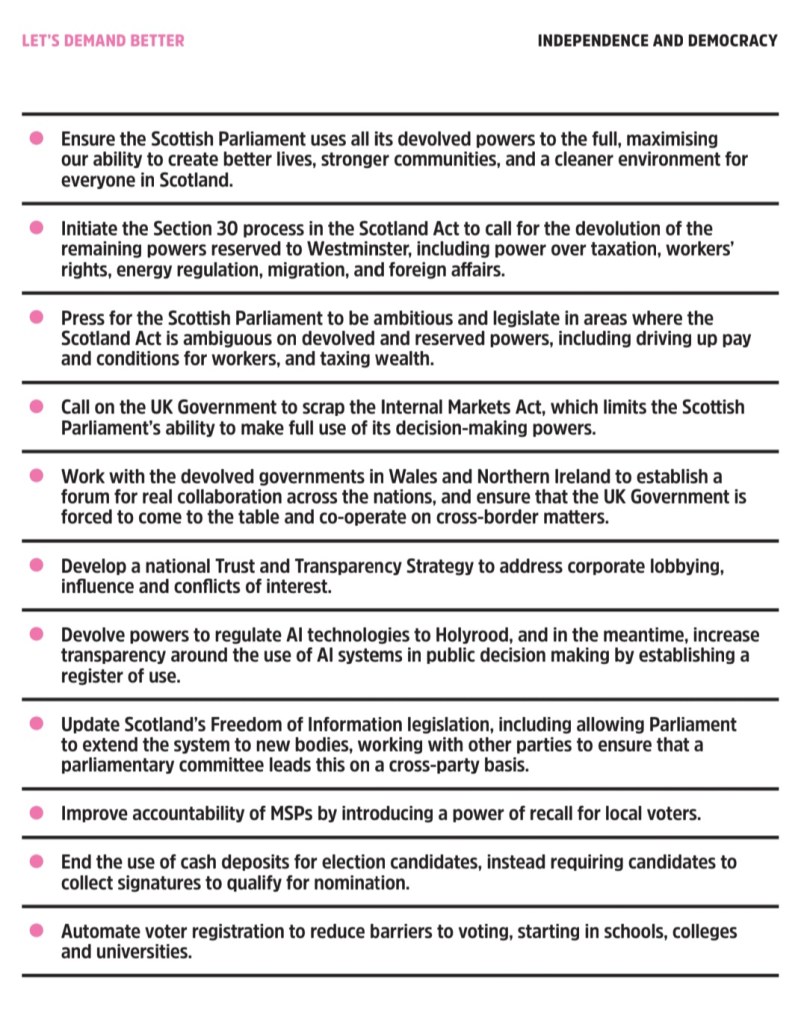
Unsurprisingly, the Greens reaffirm their commitment to independence, linking it with their wider policies on democracy in one clear section. Notably the party doesn’t even mention a referendum but calls for the devolution of foreign affairs.

Positive steps to improve Scottish democracy include a proposals for a Trust and Transparency Strategy and the introduction of a recall rule for MSPs.

The ending of cash deposits for election candidates is also welcome as that would democratise Scotland’s nominations process. Automatic voter registration is also a good inclusion, highlighting the absurdity that such a system isn’t already in place.

READ MORE: Manifesto 2026: How would Scottish Labour and Anas Sarwar reform democracy?

Local democracy

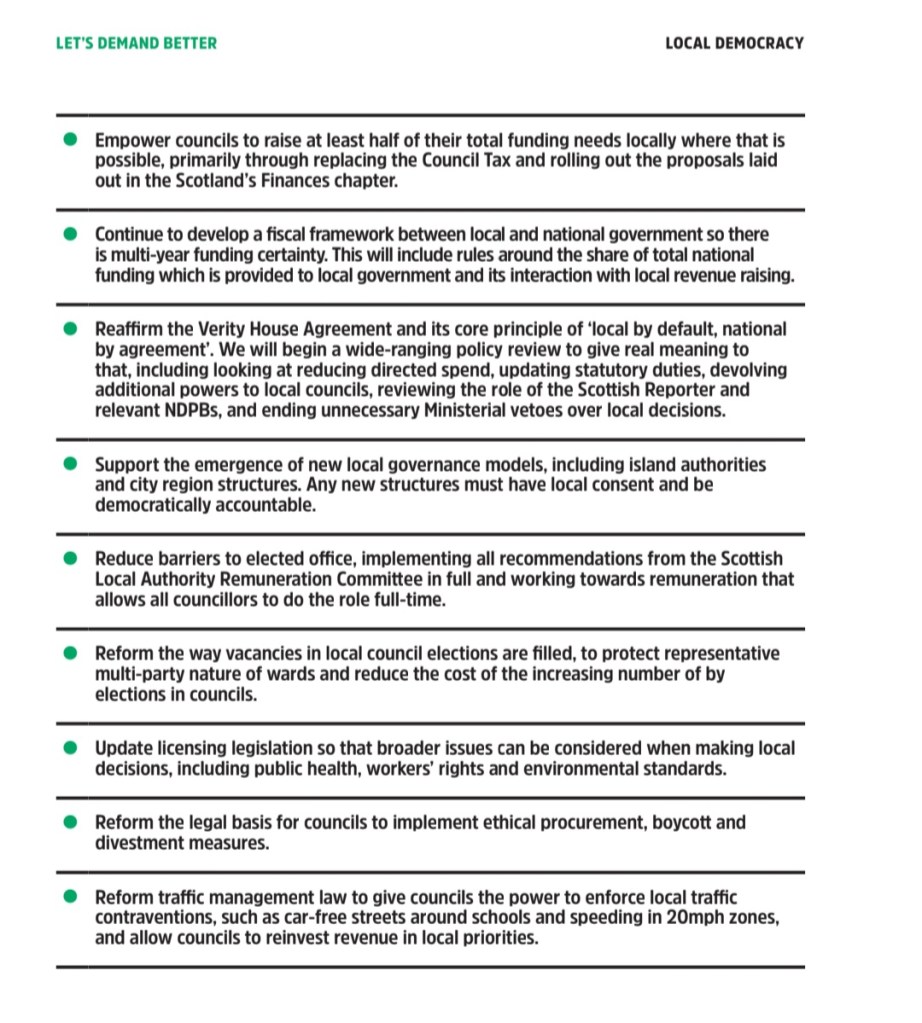
The manifesto also has a dedicated section on local democracy.

One eye-catching proposal is the move towards making councillors a full-time position. That is something which needs a lot more thinking and financing to make it feasible.

The party also wants to reform the way vacancies are filled when councillors resign from their position. There’s a lack of detail here, but the obvious alternative to disruptive and non-representative by-elections is co-option. However, any co-option proposals would need to have strong democratic safeguards.

READ MORE: Reform UK’s manifesto: Malcolm Offord’s party on Scottish democracy

What about voting system reform?

Disappointingly, the party lacks any commitment to replace Scotland’s failing Additional Member System.

Their 2021 manifesto also lacked such a commitment while their 2016 document committed them to the Single Transferable Vote.

The party did however outline it’s support for Proportional Representation at all levels of governance in the 2024 UK General Election.

But that all said, it’s striking that there are no proposals to reform Holyrood’s Additional Member System as we hurtle towards what’s likely to be Scotland’s most disproportional election ever.

READ MORE: Will the Scottish Parliament change its voting system?

Latest poll shows how First Past the Post is failing Scotland’s Additional Member System

By Richard Wood

The new Ipsos poll for STV (the broadcaster, not the voting system) adds to existing evidence that Scotland is on track for the most unrepresentative election in Holyrood’s short history. The SNP are on track to win far more seats than they would be entitled to under a truly proportional system.

STV and Ballot Box Scotland projections for the poll (data collected 26 – 31 March) puts the SNP on 63 seats with just 39% of the list vote and 29% of the regional vote.

That’s a big disparity between seats and votes yet again even if not as stark as other polls such a Find Out Now’s recent MRP poll.

READ MORE: SNP could win unrepresentative majority on 29% of the vote, suggests MRP poll

In fact, the scale of this is shown by comparing these projected results with the results if all seats were allocated via the list element alone, which is meant to determine the proportional make-up of the Scottish Parliament. Using this measure, the SNP are actually 20 seats ahead of where they should be. The Greens, Labour and Conservatives are underrepresented by 4 seats, Reform by 5 and the Lib Dems by 3.

Ipsos 26-31 Mar seat projection (vs last poll / vs 2021 on new boundaries); AMS Ideal seats:SNP ~ 63 (+3 / nc); 43Grn ~ 17 (+1 / +7); 21RUK ~ 15 (+2 / +15); 20Lab ~ 14 (-6 / -7); 18Con ~ 12 (+2 / -19); 16LD ~ 8 (-2 / +4); 11(Projection caveats: ballotbox.scot/projections)

Ballot Box Scotland (@ballotbox.scot) 2026-04-08T11:04:52.527Z

First Past the Post is wrecking the Additional Member System

The reason for these projected mismatches between seat and vote shares is the dominance of First Past the Post seats at Holyrood combined with the SNP expected to do very well to win lots of constituencies but not on a share of the vote reflecting that success.

The rise of Reform in particular is splitting unionist votes in these constituencies, giving the SNP an advantage to come through the middle and win seats on a lower vote share. This is compounded by the Greens only standing in a handful of constituencies, limiting options for pro-independence voters on the constituency ballot.

The SNP are therefore likely to win the vast majority of constituency seats meaning other parties will make up their wins on the list ballot. However, with the SNP expected to win more seats than they would be entitled to if all seats were allocated via list votes, the number seats to be allocated to other parties falls short of the number required to correct the SNP’s overrepresentation wins on the constituency ballot.

A supermajority for independence?

Let’s be clear, this skewed link between seats and votes would be a problem no matter the party benefitting from this flaw. So, to everyone getting excited about the prospect of an SNP majority because of this, or a supermajority for independence, as democrats we should all be concerned by any distortion of the link between seats and votes. Ask yourself, how would you feel if a party you deeply oppose, such as Reform, were to benefit from this in future?

If you genuinely believe it’s a good thing that a party can do disproportionately well by winning constituencies without corrections to their overrepresentation in a mixed-member proportional system, you’re wrong – but at least you’re consistent.

If you’re in favour of this set-up to benefit your party then you should ask yourself some serious questions about your views on representative democracy.

READ MORE: Scotland’s voting system is broken – another poll suggests seats won’t match votes this May

The Additional Member System needs reform

The next Scottish Parliament must address this flaw with the Additional Member System. The simplest way to do this is to correct the imbalance between list and constituency seats, either by introducing leveling seats, adding list seats to each region or by cutting constituency MSPs and replacing them with list MSPs (if politicians are committed to 129 members).

However, these changes will only go so far and won’t address the limited power voters have over electing individuals to represent them, among other flaws of AMS. This could be addressed by switching the list ballot from closed to open, or replacing AMS altogether by introducing the STV (the Single Transferable Vote not the broadcaster this time!) or an open list PR system.

More and more evidence suggests Scotland is on track for its most unrepresentative election. The next parliament must address the issue head on.

READ ON: Will the Scottish Parliament change its voting system?

IMAGE VIA PIXABAY

When did each Scottish party launch its manifesto in 2021? When are we expecting in 2026?

By Richard Wood

The first of six parties expected to win seats in 2026’s Scottish Parliament election published its manifesto on Thursday 19 March.

Reform UK launched their manifesto with worrying proposals including cutting the number of MSPs at Holyrood to 113 and regular reviews of devolution powers.

The party launched its manifesto significantly earlier than other parties in 2021.

READ MORE: Reform UK’s manifesto: Malcolm Offord’s party on Scottish democracy

Here’s when each of the other five main parties published their manifestos in 2021:

  • 🟢 Scottish Greens: 14 April 2021
  • 🟡 Scottish National Party: 15 April 2021
  • 🟠 Scottish Liberal Democrats: 16 April 2021
  • 🔵 Scottish Conservatives: 19 April 2021
  • 🔴 Scottish Labour Party: 22 April 2021

All were published in a tight window of 14–22 April 2021.

When can we expect publication of the other manifestos in 2026?

Going by the most recent election, April looks most likely but there is little information available about when manifesto launches will actually be.

It remains to be seen whether parties stick with the mid-April clustering, or if they spread out launches.

Update:

  • The Scottish Conservatives published their manifesto on Tuesday 7 April 2026 in Edinburgh.
  • Scottish Labour published their manifesto on Monday 13 April 2026 in Edinburgh.

READ MORE: Will the Scottish Parliament change its voting system?

End the FM merry-go-round: automatic early elections could improve Scottish Government accountability

By Richard Wood

When Humza Yousaf was elected as SNP leader by party members then first minister by MSPs early last year, the prospect of another change in first minister before the next election was seen as only a fringe possibility. Not anymore. The first minister’s unilateral decision to tear up the Bute House Agreement with the Scottish Greens could very well lead to his political downfall.

The Greens are furious. Alba are opportunistic. The SNP are divided.

Instead of adding more speculation to the state of play above, I want to address the mechanics of Holyrood’s democracy and how we can improve the status quo.

A change in government leader during a parliamentary term isn’t uncommon. And in theory it shouldn’t significantly alter the trajectory of a government if parties base their government policy on their most recent manifesto. But as much as we may want to keep the personality out of politics, the real world renders this impossible. We do not have a presidential system but voters do often cast their ballots with party leaders in mind, especially in the age of televised debates, the 24-hour news cycle and social media. Furthermore, when the leader of a government is replaced, in practice this can lead to significant policy changes, deviating from manifesto promises, without any citizen input. The most extreme example of this in modern times is the rise and fall of disgraced former Prime Minister Liz Truss. The Truss government set out to chart a very different course to the one her party was elected to deliver.

READ MORE: 3 alternatives to Scotland’s proportional but flawed voting system

We live in a representative democracy where citizens elect a legislature which determines the government. Thankfully, MSPs do elect the first minister in parliament, unlike the chaotic conventions at Westminster. But when government leaders change, and crucially change policy direction from that set during the post-election government formation period (without any direct citizen input) we have to consider how accountable to voters this really is.

A province across the Atlantic offers a democratic mechanism that could be replicated at Holyrood, and indeed Westminster. The Canadian province of Newfoundland and Labrador has a landmass larger than the UK but a population smaller than Glasgow’s. Its House of Assembly has 40 members usually elected once every four years. However, when a premier is replaced between elections, an election is automatically triggered to take place within a year of the change. This happened most recently in 2021 after Liberal Andrew Fury took over from outgoing premier Dwight Ball.

Now there are drawbacks to this solution. Voter apathy resulting from multiple elections in a short space of time would be a possibility, not to mention costs of mandated additional elections. But a safeguard such as this would ensure that a change in government leadership has some input from the voters.

Of course, a third first minister in one parliamentary term has happened before. The death of Donald Dewar then the downfall of Henry MacLeish led to Jack McConnell becoming Scotland’s third first minister only a couple of years into devolution. The solution being proposed arguably would have added a layer of unnecessary chaos to the situation but it may have been less necessary back then. The Scottish Parliament had limited powers in those days and was still in its experimental phase. But now things are different. Devolution is a necessary part of our democracy, one to be protected and improved when necessary. Not to mention, the Scottish Parliament and Scottish Government both have real teeth and should be held accountable by voters when there are major leadership changes.

And while we’re on the subject of accountability, Holyrood’s five-year terms are too long. Scotland switched away from four-year terms to avoid clashes with Westminster votes under the Fixed-term Parliaments Act. With the act now repealed, Holyrood should follow Wales and return to four-year terms.

READ MORE: Scotland must follow Wales on four-year terms

The events taking place this week may very well lead to an extraordinary general election later this year. That would be an extraordinary development but if we do end up with our third first minister in just over a year then an election would give much needed input from citizens.

What happens in Newfoundland and Labrador would need tweaking for a Scottish context. It’s not perfect and I’m not wholly committed to it as a solution, but it recognises the need to strike a balance between accountability and stability. With Holyrood currently tilted away from stability, an election trigger in the event of a changed first minister might just be a long-term solution.

Image source: Scottish Government (CC by 2.0)