The Scottish Greens launched their manifesto on Tuesday 14 April, just shy of three weeks before the election in May. The party are hoping for their best ever Holyrood election result and made those intentions clear at their launch in Glasgow.
My first thought looking at the manifesto was how the title stands out as being very familiar. If you’ve had the same thought it’s because it’s rather reminiscent of a previous Liberal Democrat slogan “demand better”.
The Scottish Lib Dem manifesto is due on Friday while the SNP are expected to publish theirs on Thursday.
This follows Reform, the Scottish Conservatives and Scottish Labour who have all published their plans.
Independence and democracy
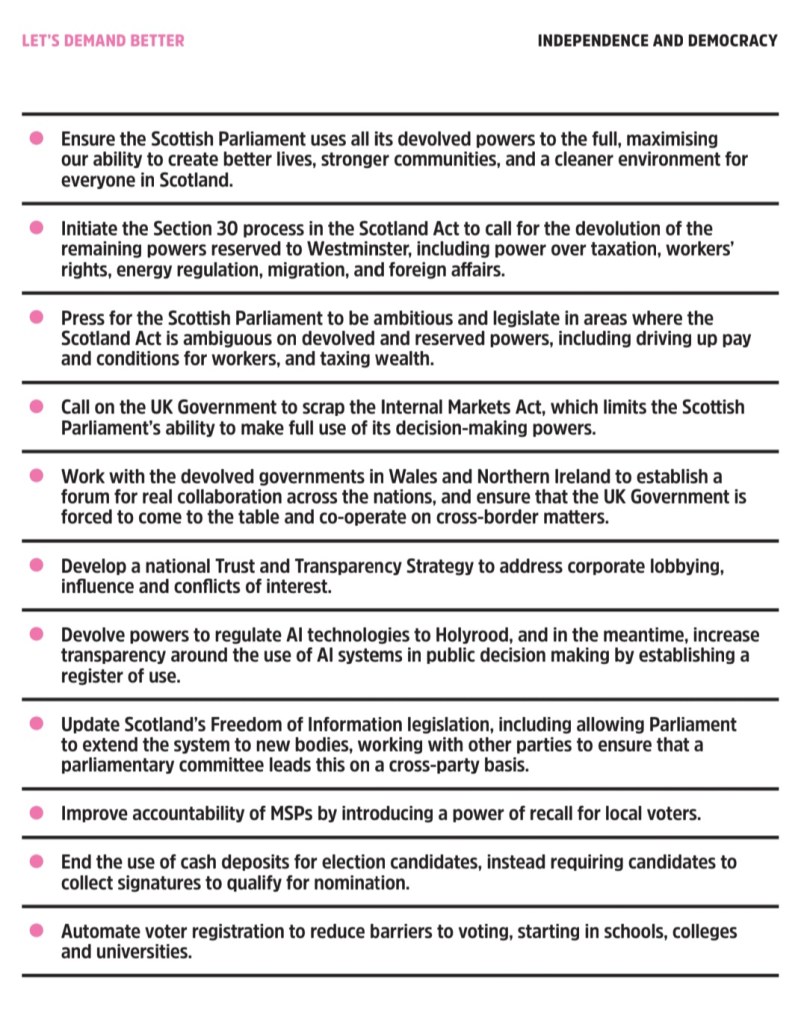
Unsurprisingly, the Greens reaffirm their commitment to independence, linking it with their wider policies on democracy in one clear section. Notably the party doesn’t even mention a referendum but calls for the devolution of foreign affairs.
Positive steps to improve Scottish democracy include a proposals for a Trust and Transparency Strategy and the introduction of a recall rule for MSPs.
The ending of cash deposits for election candidates is also welcome as that would democratise Scotland’s nominations process. Automatic voter registration is also a good inclusion, highlighting the absurdity that such a system isn’t already in place.
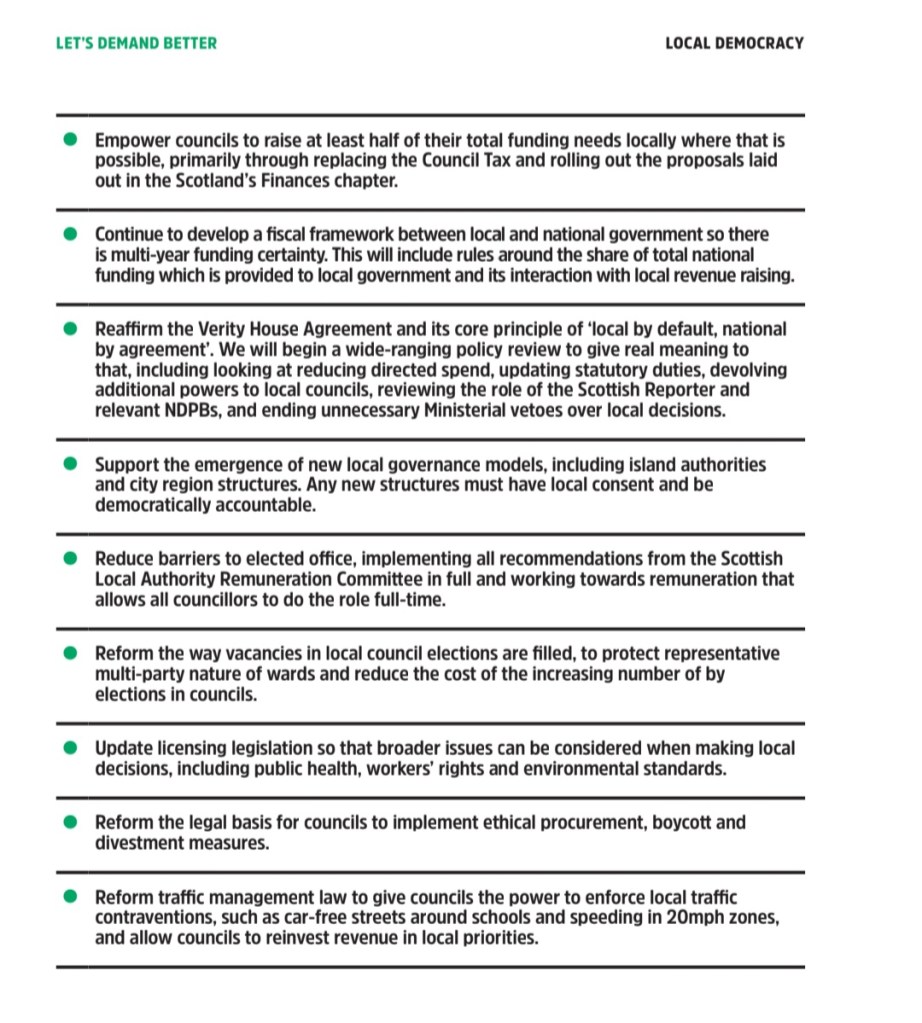
The manifesto also has a dedicated section on local democracy.
One eye-catching proposal is the move towards making councillors a full-time position. That is something which needs a lot more thinking and financing to make it feasible.
The party also wants to reform the way vacancies are filled when councillors resign from their position. There’s a lack of detail here, but the obvious alternative to disruptive and non-representative by-elections is co-option. However, any co-option proposals would need to have strong democratic safeguards.
Disappointingly, the party lacks any commitment to replace Scotland’s failing Additional Member System.
Their 2021 manifesto also lacked such a commitment while their 2016 document committed them to the Single Transferable Vote.
The party did however outline it’s support for Proportional Representation at all levels of governance in the 2024 UK General Election.
But that all said, it’s striking that there are no proposals to reform Holyrood’s Additional Member System as we hurtle towards what’s likely to be Scotland’s most disproportional election ever.
The Scottish Labour leader Anas Sarwar published his party’s manifesto for the 2026 election on Monday 13 April 2026. Here’s what the party has pledged to do if it defies the odds and is returned to power after nineteen years in opposition at Holyrood.
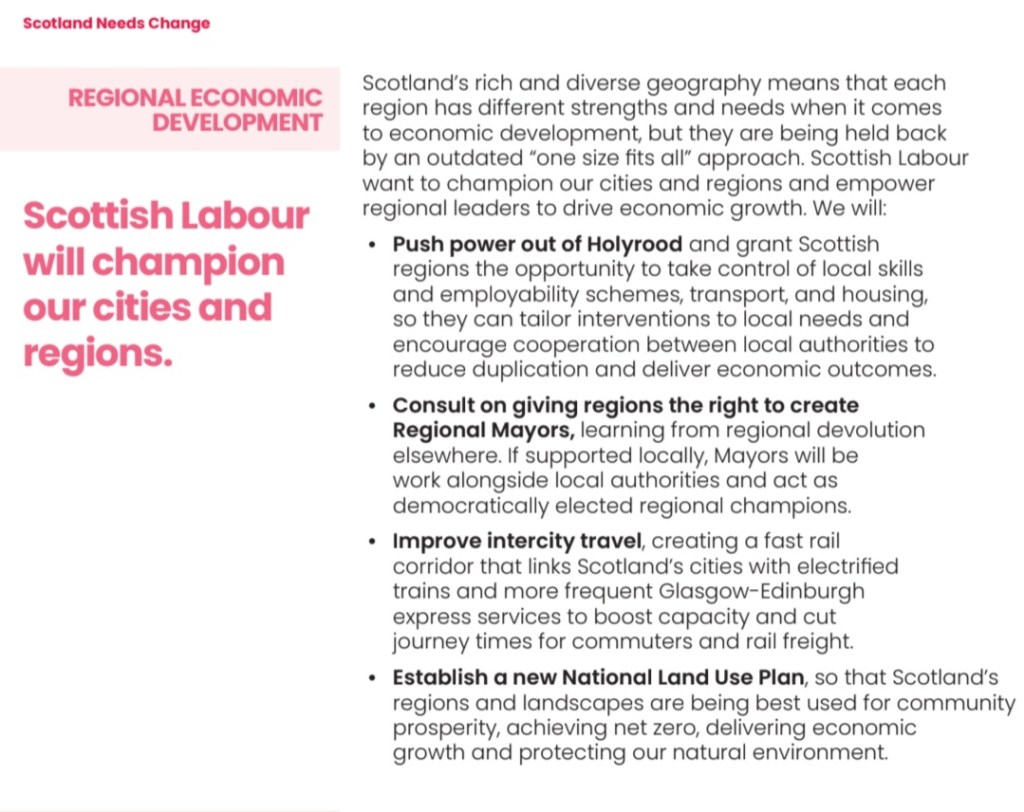
Scottish Labour want regional mayors for regions that want them
The manifesto commits the party to consulting on regional mayors, learning from blueprints in England. This isn’t a surprise and has been floated by Anas Sarwar previously. Crucially, the party only supports mayors if there is local support.
Regional mayors sound like an answer to re-energise local democracy in Scotland by having one single figure of accountability who can champion local interests. But regional mayors risk putting a lot of power into one person’s hands while also limiting multi-party politics at a time where people have a wide range of views on issues. Any proposals for such mayors should be carefully considered, as representative as possible and actively supported by local people. They’re not necessarily right for Scotland, but if they do ever go ahead they must be robust as possible with strong safeguards to ensure multi-party representation and real voter power over them.
Anas Sarwar hopes to decentrentralise power away from Holyrood
The other plank of Scottish Labour’s limited democracy plans for Scotland is to “push decision making power out of Holyrood so local people have more of a say over public services” as part of a Local Democracy Act.
They pledge to: “Push power out of Holyrood and grant Scottish regions the opportunity to take control of local skills and employability schemes, transport, and housingso they can tailor interventions to ocal needs andencourage cooperation between local authorities toreduce duplication and deliver economic outcomes.”
There’s also an interesting idea to force statutory consultations when local councils plan to cut local services such as libraries.
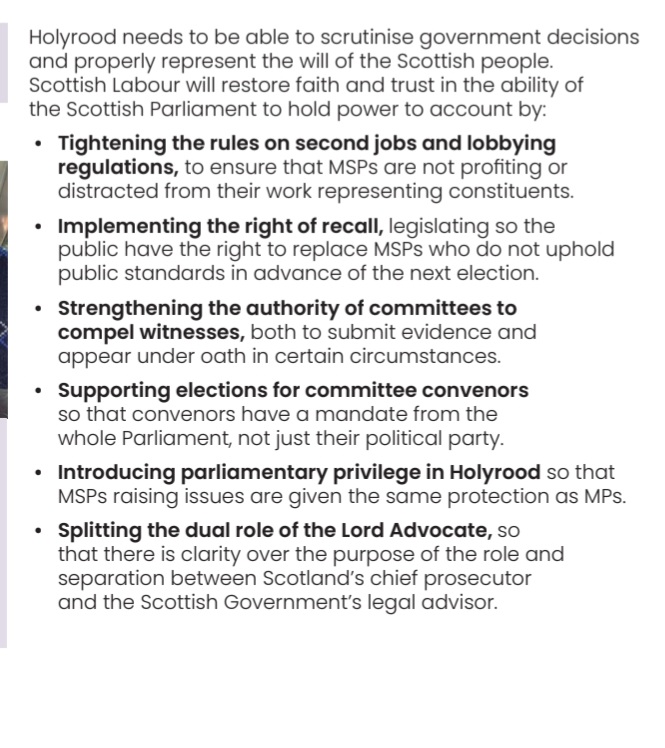
Ambitious plans to enhance accountability at Holyrood: second job rules and empowering committees
After a worrying manifesto from Reform on the democracy front and lacklustre democracy reform proposals from the Scottish Conservatives, Scottish Labour have some welcome ideas to improve accountability in the Scottish Parliament.
This includes welcome regulation over on second jobs for MSPs and lobbying.
There’s also a proposal to introduce a right to recall MSPs who don’t live up to public standards, which is welcome to see after proposals faltered in the last parliament.
Scottish Labour also want to strengthen committees by giving them teeth to compel witnesses and by electing committee convenors, which is due to happen regardless.
The proposal to provide parliamentary privilege to MSPs is also welcome to strengthen the legitimacy of MSPs on a par with MPs who already have that right.
And lastly, there’s another welcome pledge to split the role of the Lord Advocate to separate the responsibilities of Scotland’s chief prosecutor and the Scottish Government’s legal advisor, a proposal that’s long over due.
The manifesto makes no mention of improving Scotland’s Additional Member System which could well deliver Scotland’s least representative election since 1999.
Disappointingly, there’s also no commitment to revert to four-year fixed terms so voters have a more regular say on who represents them.
Have the SNP, the Scottish Lib Dems and other parties published their manifestos?
Reform UK launched their Scottish manifesto first, publishing their document at the end of March.
While the Russell Findlay’s Scottish Conservatives published theirs on Tuesday 7 April, a month before the vote.
The SNP, Scottish Greens and Liberal Democrats are yet to publish their own policies ahead of the vote.
The Senedd Cymru (Welsh Parliament) voted to pass the Senedd Cymru (Member Accountability and Elections) Bill on Tuesday 17 March.
The Bill soon to be Act outlines some key reforms, changing democratic processes at play in the next Welsh Parliament.
Members of the Senedd (MSs) backed the Bill, which includes the introduction of recall rules for MSs to be recalled and replaced after the next election in certain specific circumstances.
Empowering constituents to hold their representatives accountable builds on other welcome reforms in Wales – reforms that the next Scottish Parliament should consider. The Senedd recently reverted to four-year terms (a change that will further improve accountability) and introduced a new voting system, which, while not perfect, is a step-up from the Additional Member System previously used for Cardiff Bay elections.
The law introduces a recall system triggered either automatically by any prison sentence, even suspended ones, or following a recommendation from the Standards of Conduct Committee for serious misconduct. This is subject to a Senedd-wide vote.
An empty seat would be filled automatically by the next available candidate on the party’s list. This has its merits by retaining proportionality in the Senedd, but does limit Senedd accountability from voters.
The new law also strengthens the standards system by requiring each Senedd to establish a committee with possible independent members, expands the Commissioner for Standards’ investigative powers, and requires the Welsh Government to ban false statements in Senedd election rules. This last one is, in theory a positive development, but will have significant challenges to ensure is proportionate and effective.
Under the Recall of MPs Act 2015, an MP faces recall if they are convicted of an offence and receive a prison sentence, suspended from the House of Commons for at least 10 sitting days (or 14 calendar days), or found guilty of false or misleading expenses claims. If 10% of voters sign a recall petition, the seat is vacated and a by-election is triggered.
Constituency MSPs would have been recalled if 10% of local voters supported a petition, like at Westminster. Regional MSPs would have been removed if a majority voted for recall, with replacements coming from their party list. In addition, independent MSP seats would stay vacant until the next election.
The confirmation of a by-election in Rutherglen and Hamilton West following a recall petition demonstrates the case for a recall mechanism for MSPs.
The by-election, which will be held some point after parliament returns from summer recess, is the first to take place in Scotland under the Recall of MPs Act (2015). The most recent Westminster by-election to take place in Scotland was in Airdrie & Shotts in May 2021 when the SNP’s Neil Gray switched from Westminster to Holyrood.
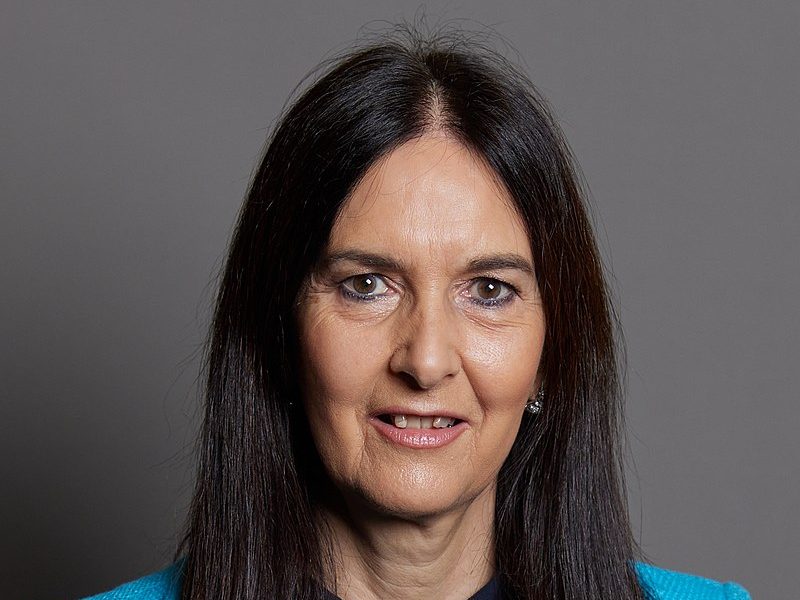
The by-election in Rutherglen and Hamilton West got the go ahead from constituents following over 10% of them signing a recall petition after sitting MP Margaret Ferrier was suspended from the House of Commons for 30 days.
The Recall of MPs Act (2015) empowers constituents to kick out suspsended MPs, with appropriate checks and balances to ensure it doesn’t become a political tool.
The ability to recall MPs in certain circumstances puts powers in the hands of constituents, allowing MPs to be held accountable for their actions.
The Scottish Parliament must follow Westminster’s lead and introduce a Recall of MSPs act to strengthen accountability in Scottish democracy.
The upcoming by-election looks set to be a heated contest between Labour and the SNP. A win for Labour would be hailed as a resurgent moment for the party in Scotland.
Central Scotland MSP Graham Simpson has lodged his proposal for a Removal from Office and Recall Bill (19 January 2022). This potential Act of Parliament is a direct response to the ministerial resignation of then Finance Secretary Derek Mackay in February 2020, as a result of him messaging a teenage boy, and his subsequent disappearance from parliament while claiming a full salary as an MSP.
If passed in the Scottish Parliament, the Bill will make MSPs more accountable to the electorate by setting out new terms to remove MSPs from office where appropriate. The bill has three main functions:
To remove absent MSPs from office
To lower the jail time threshold for removal from office
To establish a system of recall for MSPs
Here are five reasons why all five of Scotland’s political parties should come together and pass the Bill.
1. Democratic duty of participation
Legislators have a duty to act on behalf of their constituents and attend parliament. Turning up at parliament is the bare minimum that should be required of MSPs. Under the status-quo, MSPs can remain in post even if they don’t show up for work (while claiming a salary!). This is simply unacceptable.
The Removal from Office and Recall Bill will mean automatic expulsion from parliament if an MSP fails to show up for six months. Importantly, the Bill will have a provision so that MSPs on maternity leave or those affected by ill-health are exempt from this reform.
This automatic expulsion will address the problem of non-attendance and is the right step forward for Scottish democracy. It is also worth noting that such a provision has existed in government as a result of Section 35 of the Local Government (Scotland) Act 1973. To put that in context, the Scottish Parliament is almost half a century behind Scottish councils. It must catch up.
Holyrood must learn from the rules of local government and support Graham Simpson’s bill.
Elected officials should act and behave in a way that is expected of them. Standards in public life are extremely important – as have been shown by events of the last few months in Westminster. It is therefore vital that anyone jailed while serving as an MSP should not be in their position.
The current rules ban MSPs from their job if they go to jail for more than a year. This means that representatives jailed for a year or less can remain in post, a loophole that is simply unacceptable. This could have happened in 2013 had Bill Walker MSP not resigned from parliament. Graham Simpson MSP highlights this in his proposal, saying:
Bill Walker, the former MSP for Dunfermline, was convicted of 23 charges of assault and one of breach of the peace in August 2013, yet was sentenced to just a year in prison. If he had not resigned then the Parliament would have had no power available to it to remove him and, consequently, the people of Dunfermline would have been represented for a year by an MSP in jail.
Graham Simpson MSP (19 January 2022)
Thankfully, the Removal from Office and Recall Bill will ratify this problem by containing a provision to expel MSPs from parliament of they go to jail for one year or less.
In addition to the moral argument that MSPs have a duty to attend parliament, participate in debates and vote, there is also the issue of money. Absent MSPs mean wasted taxpayer money.
When Derek Mackay stopped turning up to parliament between February 2020 and May 2021, he cost the taxpayers a heft sum for doing very little – if anything – at all.
The Removal from Office and Recall Bill will ensure that MSPs absent for six months or more (without a valid reason) are booted out of Holyrood. The main argument for this is to ensure that constituents are fairly represented in parliament but their is also a strong case to ensure taxpayer money is not wasted, adding weight the need for change.
The Removal from Office and Recall Bill crucially adds a mechanism allowing constituents to recall their MSPs. This is vital to improve accountability so that the public have a say on members that bring the parliament into disrepute.
Of course, this needs to be done carefully to ensure the mechanism doesn’t become a political tool. Appropriate checks and balances can be put in place, taking a steer from the process set-up at Westminster in 2015. The UK’s Recall of MPs Act 2015 sets out the following three conditions for a recall petition:
A custodial prison sentence (including a suspended sentence)
Suspension from the House of at least 10 sitting days or 14 calendar days, following a report by the Committee on Standards
A conviction for providing false or misleading expenses claims
Furthermore such a system should also account for both types of MSPs elected (constituency and regional). The exact way to do this is hard to say as highlighted in the Bill’s proposals.
5. Positive experiences from Westminster and around the world
Lastly, the proposed measures in the Removal from Office and Recall Bill have been tried and tested elsewhere, showing that they are workable. Upgrade Holyrood advocates for democratic best practice and learning from how other democracies conduct themselves. The functions proposed in the bill have a history of working elsewhere.
The House of Commons has had a recall rule since 2015 and to date has been used on three occasions. Crucially, it has not been used as a political tool and the mechanism is largely viewed as a success. While there are still questions to be answered about how this would practically work for regional members, it is right that the balanced approach of the recall process at Westminster should be the starting point for reform of the Scottish Parliament.
The Scottish Parliament Information Centre has outlined other models from elsewhere where recall rules have been successful.
Next steps for the bill – contribute to the consultation and write to your MSP
The Bill has a long way to becoming law as it needs the support of MSPs from different parties to overcome the first hurdle to be introduced to the chamber. One action to help move this forward is to ask your MSPs to back the motion. You can find out who your MSPs are here.
Another way to help out is by contributing to the open consultation, which will close on 13 April 2022. Make your case for the Removal from Office and Recall Bill here.
You can read more about the consultation and the Bill here.
Where do Scotland’s political parties stand on the bill?
The Scottish Conservatives and Scottish Liberal Democrats both supported recall proposals in their 2021 manifestos, the former’s leading to Graham Simpson’s bill.
Scottish Labour did not include a similar proposal but have since come around to supporting the bill, as reported by Holyrood Magazine. Scotland’s two governing parties, the SNP and Scottish Greens, have yet to voice their support.
These days, Scottish politics is viewed as extremely polarised but surely this is one issue where Holyrood’s five parties can come together. Even if there are disagreements on some of the detail, surely there is enough common ground on the principles to introduce and pass the bill.
Improving Scotland’s democracy is central to Upgrade Holyrood’s mission. Scotland needs better Proportional Representation, a recall rule, an end to dual mandates, and other changes that will ultimately better our country’s democratic design.
Both the Scottish Conservatives and Scottish Lib Dems supported a recall rule for MSPs that bring parliament into disrepute in their 2021 manifestos. The Conservatives detailed that this would include the right for constituents to recall MSPs if they stopped turning up for six months.
Scottish Conservative leader Douglas Ross has since renewed his party’s plan, as reported by the BBC.
Speaking at the Conservative Party Conference in Manchester, Ross said:
“The ex-SNP finance secretary, Derek Mackay, resigned in disgrace and was never seen in parliament again.
“Yet Scottish taxpayers were forced to continue to pay him £100,000.
“In no other job could someone pocket a six-figure salary while hiding at home. So why would we stand for it in the Scottish Parliament?”
Douglas Ross
The so-called Mackay’s Law is a welcome proposal and something all parties can and should get behind. That former Minister Derek Mackay was able to claim a salary and not show up for work for over a year is detrimental democratic practice. Voters should be empowered and represented, not diminished and ignored.
However, it is difficult to take the Scottish Conservative leader too seriously on this matter. There is a level of hypocrisy here as Douglas Ross is often absent from his role as an MSP. This is because he is also an MP, and therefore has to be in both Westminster and Holyrood.
He is of course not absent for six months spells, but by holding two roles he is not fully effectively representing his constituents.
Dual mandates are ultimately unfair on voters who deserve full-time representatives in both Edinburgh and London. Not part-timers.
Ross’ proposal of a Mackay’s Law is sound policy that would improve our democracy but the fact he holds a dual mandate makes his position somewhat hypocritical.
Douglas Ross must resign from one of his roles to be taken seriously as someone championing better representative democracy.
When it comes to democratic processes, there’s a lot that Westminster can learn from Holyrood but there’s one really obvious improvement Holyrood can make by learning from Westminster.
Despite being stuck in the past, with its unrepresentative voting system, the undemocratic House of Lords and much more, the introduction of a recall process at Westminster was a welcome innovation that has made British democracy more accountable.
Westminster’s recall system was introduced in 2015 by the coalition government. The Recall of MPs Act (2015) provides three circumstances where a recall petition can come into force. If any MP recieves a custodial prison sentence, is suspended from the House or is convicted for providing false or misleading expenses claims, then a recall petition is triggered.
If this happens to an MP, their constituents will be able to sign a petition and if 10% of constituents sign in the set time period, then a by-election will be triggered.
There is no similar provision for MSPs in Scotland despite calls for a recall mechanism during the last parliament.
Only two parties called for the introduction of a recall process during the last election – the Lib Dems and the Conservatives. Here’s what they said:
Scottish Liberal Democrats – “Continue to call for the introduction of a recall system for elected representatives.”
Scottish Conservatives – “At Westminster, there are clear rules around recall, allowing a by-election to take place in certain circumstances, but no such rules exist for MSPs. We will introduce Mackay’s Law, allowing the public to recall MSPs who have broken the law, grossly undermined trust or cailed to contribute to Parliament for more than six months. This will mean that Scotland will never again face the scandal of a disgraced former minister remaining an MSP, earning over £100,000 and failing to represent his constituents.”
That there have been six years since the introduction of the recall process at Westminster gives an opportunity to learn from the legislation in London – as well as from elsewhere.
The House of Commons system ensures that constituents can’t just recall politicans for any reason. There are clearly defined routes to recall – sensibly setting boundaries although there is room for expansion – that can be adapted for the Scottish Parliament.
The case for a recall system is as simple as it is obvious. MSPs who bring the Scottish Parliament into disrepute have no place in the chamber. The exact reasons that would lead to a recall petition (and potential by- election) would need defined but those outlined for MPs at Westminster, as well as the detailed reasons offered in the Scottish Conservative manifesto clearly highlight the need for a such a system. The fact that MSPs can break the law or not turn up to work and keep their job is a democratic outrage. The Scottish Parliament needs to learn from Westminster and adopt a recall process.
Scottish democracy needs an upgrade and the introduction of a recall system would help do just that.
However, there is one practical stumbling block to the introduction of a recall rule. It is worth considering the two different types of MSP at Holyrood (although Upgrade Holyrood supports switching from AMS to a more representative electoral system). Recall would ultimately lead to a by-election for any MSP elected in a single seat constituency, however, the route to recall would be more complex for a regional MSP.
There are some solutions but the answer is far from obvious:
A region-wide by-election (a fascinating prospect but one that throws up questions about the very nature of the Holyrood voting system).
A decision taken by the party that the MSP belongs to over whether to remove the MSP and let the next candidate in the list taking up the post (however, this would give a significant amount of power to parties and take away the electorate’s option to have their say).
A parliamentary vote of confidence. If the MSP loses then they would be expelled from parliament. The next candidate on that party’s list would then take their seat. This might be the most sensible option but there would need to be significant checks to ensure that it wouldn’t be abused.
The correct answer to this is unclear (and there would be similar questions if Scotland adopts the Single Transferable Vote of an Open List PR system with levelling seats), however, introducing a recall mechanism would ultimately improve Scottish democracy.
It’s time to introduce a recall rule. Let’s learn from Westminster and adopt a recall system to improve Scottish democracy.