

Manifesto 2026: How would Scottish Labour and Anas Sarwar reform democracy?

By Richard Wood

The Scottish Labour leader Anas Sarwar published his party’s manifesto for the 2026 election on Monday 13 April 2026. Here’s what the party has pledged to do if it defies the odds and is returned to power after nineteen years in opposition at Holyrood.

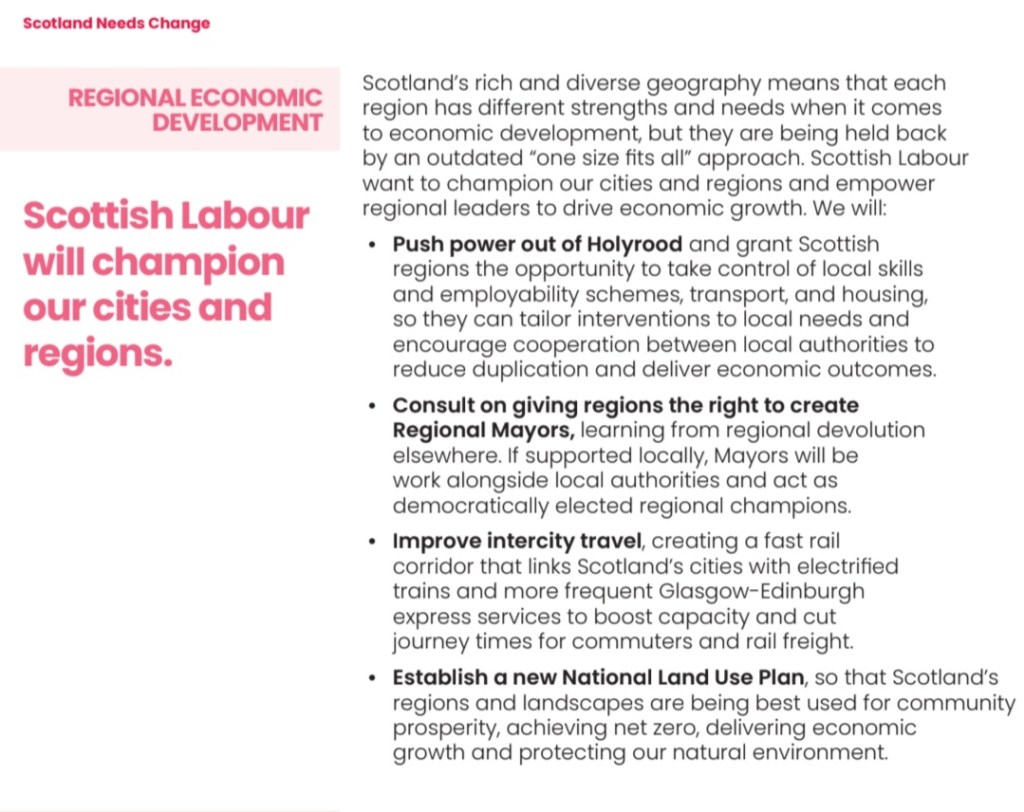
Scottish Labour want regional mayors for regions that want them

The manifesto commits the party to consulting on regional mayors, learning from blueprints in England. This isn’t a surprise and has been floated by Anas Sarwar previously. Crucially, the party only supports mayors if there is local support.

Regional mayors sound like an answer to re-energise local democracy in Scotland by having one single figure of accountability who can champion local interests. But regional mayors risk putting a lot of power into one person’s hands while also limiting multi-party politics at a time where people have a wide range of views on issues. Any proposals for such mayors should be carefully considered, as representative as possible and actively supported by local people. They’re not necessarily right for Scotland, but if they do ever go ahead they must be robust as possible with strong safeguards to ensure multi-party representation and real voter power over them.

READ MORE: 3 tests Anas Sarwar’s Scottish metro mayor plans must meet

Anas Sarwar hopes to decentrentralise power away from Holyrood

The other plank of Scottish Labour’s limited democracy plans for Scotland is to “push decision making power out of Holyrood so local people have more of a say over public services” as part of a Local Democracy Act.

They pledge to: “Push power out of Holyrood and grant Scottish regions the opportunity to take control of local skills and employability schemes, transport, and housingso they can tailor interventions to ocal needs andencourage cooperation between local authorities toreduce duplication and deliver economic outcomes.”

There’s also an interesting idea to force statutory consultations when local councils plan to cut local services such as libraries.

READ MORE: Will the Scottish Parliament change its voting system?
Ambitious plans to enhance accountability at Holyrood: second job rules and empowering committees

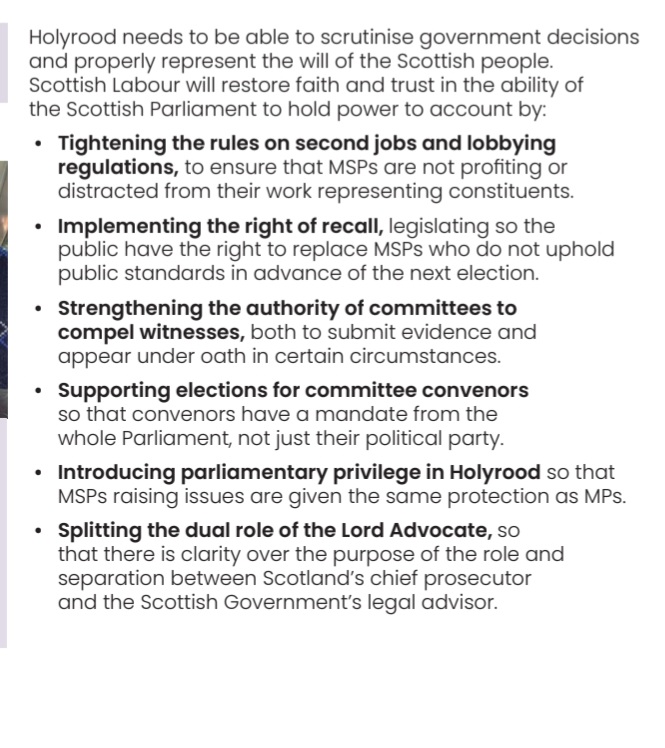
After a worrying manifesto from Reform on the democracy front and lacklustre democracy reform proposals from the Scottish Conservatives, Scottish Labour have some welcome ideas to improve accountability in the Scottish Parliament.

This includes welcome regulation over on second jobs for MSPs and lobbying.

There’s also a proposal to introduce a right to recall MSPs who don’t live up to public standards, which is welcome to see after proposals faltered in the last parliament.

Scottish Labour also want to strengthen committees by giving them teeth to compel witnesses and by electing committee convenors, which is due to happen regardless.

The proposal to provide parliamentary privilege to MSPs is also welcome to strengthen the legitimacy of MSPs on a par with MPs who already have that right.

And lastly, there’s another welcome pledge to split the role of the Lord Advocate to separate the responsibilities of Scotland’s chief prosecutor and the Scottish Government’s legal advisor, a proposal that’s long over due.

READ MORE: SNP could win unrepresentative majority on 29% of the vote, suggests MRP poll
What about voting system reform?

The manifesto makes no mention of improving Scotland’s Additional Member System which could well deliver Scotland’s least representative election since 1999.

Disappointingly, there’s also no commitment to revert to four-year fixed terms so voters have a more regular say on who represents them.

Have the SNP, the Scottish Lib Dems and other parties published their manifestos?

Reform UK launched their Scottish manifesto first, publishing their document at the end of March.

While the Russell Findlay’s Scottish Conservatives published theirs on Tuesday 7 April, a month before the vote.

The SNP, Scottish Greens and Liberal Democrats are yet to publish their own policies ahead of the vote.

The full Scottish Labour manifesto can be read here.

Images taken from Scottish Labour election manifesto 2026.

READ MORE: Reform UK’s manifesto: Malcolm Offord’s party on Scottish democracy

READ MORE: The Scottish Conservative manifesto is here: what does it say on democracy?

3 tests Anas Sarwar’s Scottish metro mayor plans must meet

By Richard Wood

Leader of the Scottish Labour Party Anas Sarwar has called for Scottish metro mayors in a speech marking 25 years of devolution.

The remarks follow his party winning all but one metro mayoral seats up for election south of the border this May, the most notable of which was Richard Parker’s win against incumbent Conservative Mayor Andy Street.

The main appeal of metro mayors is their ability to champion the areas they represent on scale not quite seen by constituency MPs. There’s little denying that Andy Burnham is able to grab media and government attention in a unique way suited to our current news and political landscape. Not to mention that to many voters elected mayors are seen as more accountable than a largely unnoticed council cabinet committee.

Furthermore, a metro mayor equivalent for Dundee for example could give different parts of Scotland the political attention they deserve, shifting focus away from the central belt.

READ MORE: Scottish Tory Murdo Fraser supports electoral reform at Holyrood

However, metro mayors are far from a panacea. Despite the profile brought by the likes of Andy Burnham and Sadiq Khan, the elections that put them in power are characterised by low turnout.

On top of that, elected mayors mark a shift away from deriving local government executives from elected councils. Concentrating such powers in one individuals would be a major jump from the culture of consensus set out with the set-up of the Scottish Parliament and shift to STV for local authorities, pushing Scotland in a more majoritarian direction.

Additionally, Scottish local government has far bigger problems such as funding and structural issues that imposing elected mayors or provosts won’t fix.

Any discussion about moving to a metro mayor system must be open, honest and frank. Crucially, three tests must be met if Scotland were to go down the path of introducing metro mayors.

READ MORE: Scottish Labour MSP “sympathetic” to Scottish electoral reform

1. Checks and balances

    Elected mayors put a significant amount of power in the hands of one individual. Yes, they have a team that do much of the day to day work but ultimately directly elected executive mayors arguably give mayors too much power. A simple truth about democracy is that despite best intentions, one individual cannot fairly represent the views of all their constituents. Any elected mayors would need to be accountable to voters at elections and to elected councils – proportionately elected and with real powers of scrutiny – throughout their term.

    2. Preferential voting

    The UK government’s Election Act changed the voting system for directly elected executive mayors from the Supplementary Vote to First Past the Post. The Supplementary Vote was far from perfect but it at least gave a broader mandate to elected mayors as opposed to FPTP. If Scotland follows England, we should learn from the mistakes of the Elections Act and use the Alternative Vote to elect mayors. A preferential voting system would empower voters and give mayors the broad mandates they need to lead.

    3. Referendum

    Lastly, directly elected executive mayors should not be imposed on a populace without consent, whether that be by any new Scottish Government or local authorities themselves. Any proposals should be subject to a significant consultation process and conclude with a referendum to determine whether they are the right decision for each community. Likewise, communities should be able to vote to revert to a cabinet system for local government if they choose.

    READ MORE: Scottish election manifestos: democratic reform pledges compared

    The adoption of directly elected executive Scottish mayors is an intriguing prospect but it would have significant downsides, notably the concentration of executive power in one pair of hands and a major shift away from the consensus-building democracy that has characterised Scotland in the age of devolution.

    There are of course potential benefits as seen in England but any concrete proposals for reform should be carefully examined and criticised where appropriate.

    If Scottish Labour, or any other party, do ever introduce elected mayors then their implementation must pass the three tests outlined above. However, lawmakers should in the first instance focus on more pressing issues facing local authorities as opposed to looking south for flashy reforms that aren’t necessarily what they seem. Anas Sarwar should consider all this if introducing metro mayors is ever something he gets the powers to do.

    IMAGE SOURCE: This work contains Scottish Parliamentary information licensed under the Open Scottish Parliament Licence.

    Could Scottish Labour really leapfrog the SNP and Conservatives in 2026?

    By Richard Wood

    UPDATE APRIL 2026: The answer to this is very much a resounding no. There’s a chance Scottish Labour will edge out Reform UK and come second, but they’re likely to do so on fewer seats than they won in 2021. The SNP are all but guaranteed to win the most number of seats, and by some mile at that.

    Until 2023, the last time Scottish Labour led a Holyrood poll was in 2014. Since then, our politics have shifted dramatically. The UK voted to leave the EU, Nicola Sturgeon took over from Alex Salmond before being replaced by Humza Yousaf and Covid-19 changed the world – to mention some of many major changes. Over the past decade, the SNP have established their hegemony, winning election after election in Scotland, but is that starting to wane?

    This year (2023) has seen nine polls putting Scottish Labour ahead of the SNP in regional voting intentions. Some caveats: these include polls from Redfield & Winton, which arguably has some methodological validity problems, and none of these polls have put Scottish Labour above 30%. Not to mention, just one poll (a Redfield & Winton poll) puts their lead over the SNP as statistically significant.

    READ MORE: Scottish Labour MSP “sympathetic” to Scottish electoral reform

    From these polls alone, Scottish Labour look likely to reverse their decline. The party has only ever lost seats at Scottish Parliament elections so this would be a major improvement. But the extent of any reversal is far from clear. I would put money on Anas Sarwar’s party gaining seats in 2026 but significant hurdles remain.

    There are three clear things to watch over the coming two and a half years until the 2026 election (yes, two-and-a-half years, which is why we need to re-introduce four-year terms at Holyrood):

    1. Labour in Westminster

    Unless something goes terribly wrong for Labour – which is entirely possible in election campaigns, just look at Theresa May’s poor 2017 election – the party is on course to win a majority of seats at Westminster. If Labour do well in Scotland, there’s every chance that translates into Labour votes at Holyrood.

    The party has been polling better in Scotland for Westminster votes for Holyrood votes, likely as that is a contest between Labour and the Conservatives on a UK-wide scale, squeezing out the SNP. If Labour show they’re back in 2024 then that can help their chances at Holyrood in 2026.

    However, this does come with risks. Labour’s UK-wide strategy of being small-c conservative on radical policy commitments may win them the election but if that continues in government, the SNP will certainly take advantage of that. If Labour do well in Scotland in 2024, I suspect there will be an immediate polling bounce in Holyrood voting intentions but whether that continues will very much depend on what a Starmer government looks like in practice. Not to mention how much distance Anas Sarwar can put between his party in Scotland and Starmer’s in Westminster when it matters.

    2. The SNP and independennce

    Despite significant political turmoil since 2014, the dial has barely moved on independence. The country is split roughly 50-50, with polls swinging back and forth between ‘yes’ and ‘no’. With the Conservatives looking like they’re on their way out, that can only help Scottish Labour’s case with the message that independence isn’t the only way to get rid of the Conservatives. However, this again is reliant on the assumption that Starmer governs differently from Sunak. There will surely be far more professionalism, integrity and accountability from Starmer but if the party sticks to its cautious, conservative approach then that can only give ammunition to the SNP.

    On the other side, there’s also the independence dilemma for the SNP. Their strategy to achieve independence has stalled. As things stand, the practical route to independence – another referendum – is unlikely to happen this side of a Holyrood election. The question is, can they sustain their hegemony while failing to deliver what they’ve been promising since 2011? Maybe they will, but Salmond and others will be waiting for an opportunity to take advantage of the situation.

    READ MORE: 6 Scottish Labour 2021 manifesto pledges on improving democracy

    3. The Scottish Conservatives

    So far in this article I’ve taken the assumption that Conservatives will go backwards at the next election. I’d be surprised if that wasn’t confirmed in 2026. Johnson, Truss and Sunak have inflicted considerable damage on their party. There’s a base-level they won’t go below in Scotland but as things stand they may well approach it.

    That is of course if they don’t carve out a distinct narrative ahead of 2026 and shoulder up some of the unionist support they secured in recent years. Again, with Labour likely to do well in Westminster and with the SNP lacking in Nicola Sturgeon, they will be less likely to feed off the independence-unionist split that empowered them under Ruth Davidson and Douglas Ross. Nonetheless, there’s always the possibility of them changing leader trying something different in 2026. A Scottish Conservative resurgence looks unlikely, but Labour should be wary of any developments.

    READ MORE: Labour conference votes in favour of Proportional Representation

    As ever there are a range of factors in determining how a country will vote. In addition to these things to watch out for in the coming two-and-a-half years, there’s also the election campaign itself. As policies fall apart and candidates face mishaps in the heat of an election campaign, the views of the public can change quickly.

    Put simply, no one can tell which way Scotland will vote in 2026 but signs currently point to a Scottish Labour party on the up. Any increase in seats will be a win in itself, reversing a decline since the start of devolution way back in 1999. Supplanting the Scottish Conservatives as the second largest party is surely achievable as things stand. But as for leapfrogging both them and the SNP to become the largest party (and likely take Bute House) that is objectively a tough ask. It is of course certainly possible. With a charismatic leader in Anas Sarwar in the face of a tired SNP after seventeen years in government and a chaotic Conservative party in need of a reboot, the stars could well align.

    READ MORE: 7 reforms to improve the Scottish Parliament

    Back in 2011, Canada’s NDP supplanted the Liberals in a dramatic election that saw the Leader of the Opposition Michael Ignatieff lose his seat. In the immediate aftermath of that election the Liberals looked certain to be picking up the pieces for a long time. But four years later, under Justin Trudeau the Liberals surged by over 20 percentage points to win a majority of seats, leapfrogging both the governing Conservatives and the opposition NDP.

    Now of course, Scotland isn’t Canada but the pieces are moving into place for Scottish Labour to make the biggest leap of all.

    READ MORE: Canada’s 2021 election – the striking failures of First Past the Post exposed

    Image source: Pixabay

    Labour conference votes in favour of Proportional Representation

    By Richard Wood

    Delegates at the UK Labour Party Conference in Liverpool have today voted in favour of a motion to put changing the UK’s electoral system to one of Proportional Representation (PR) in the next election manifesto.

    The vote follows years of hard work from reform activists, notably the Labour for a New Democracy campaign which includes the likes of Make Votes Matter and the Labour Campaign for Electoral Reform.

    The successful vote also comes a year after a similar motion was defeated at the previous conference.

    It’s worth highlighting that 60% of local Labour parties support PR. A total of 140 sent motions to this year’s conference in favour of reform.

    Scottish Labour Leader Anas Sarwar even made the case for PR at the Labour conference. The Scottish Parliament voting system may not be perfect but it does deliver broadly proportional outcomes so it’s great to see MSPs standing up for PR at Westminster too.

    READ MORE: 12 reasons to support Proportional Representation

    Analysis – what does this mean and what next for Labour?

    This is a major step forwards on the road to Proportional Representation. The Labour Party now officially has a policy in favour of upgrading UK democracy with fair votes.

    However, it does not guarantee the inclusion of PR at the next election. Reports suggest that the party leadership may opt to exclude a commitment to PR from its 2024 manifesto.

    It remains to be seen how this will play out but one thing is certain, this is a significant moment.

    Labour for a New Democracy will no doubt keep up the pressure within the Labour Party.

    READ MORE: 3 alternatives to the Scottish Parliament’s AMS voting system

    6 Scottish Labour manifesto pledges on improving democracy

    By Richard Wood

    Scottish Labour were the last of the main five parties in Scotland to launch their manifesto ahead of the election on 6 May 2021.

    Here’s what they have pledge to support in the next parliament.

    Party overview

    Anas Sarwar’s party unveiled his party’s policy priorities on Thursday 23 April and are hoping to take second place from the Scottish Conservatives on 6 May.

    The party has lost seats at every single Scottish election since 1999 so reversing this trend would be a positive step for the party, which went from being Scotland’s dominant party in the 2007 Scottish General Election (and the 2010 UK election) to battling it out with the Conservatives for second place in 2016 and 2021.

    The party is now on its tenth permanent leader since devolution but polls suggest Anas Sarwar is cutting through. A significant win for Scottish Labour would be to take second place from Douglas Ross’ Scottish Conservatives.

    READ MORE: Scottish Labour MSP says he’s “sympathetic” to electoral reform at Holyrood

    Manifesto pledges on Scottish democracy

    The party’s main proposals on Scottish democracy in 2021 are to:

    • Devolve further powers to Holyrood (borrowing and employment rights)
    • Introduce a Clean Up Holyrood Commission
    • Elect Holyrood committee conveners via the whole Scottish Parliament
    • Give Holyrood committees more powers
    • Further devolve powers to local government
    • Introduce a “Right to Space” to ensure communities have places to meet and funding to build the capacity to participate as active citizens

    Manifesto

    The full Scottish Labour manifesto for the 2021 Scottish Parliament election can be accessed here.

    READ MORE: A comparison of the five main parties’ 2021 manifestos

    Scottish Labour and electoral reform manifesto commitments in 2016