Voters in Scotland are going to the polls on Thursday 7 May 2026 to elect 129 MSPs.
Here’s how the Scotland’s Additional Member System works.
First Past the Post seats
Scotland is divided into 73 constituencies elected via First Past the Post. In this system, you get one vote for candidates in your constituency. The candidate with the most votes in each constituency wins the seat to become the constituency MSP.
On these seats alone, the share of votes cast for each party across Scotland are unlikely to match up with the proportion of seats won. To address this disproportionality, that’s where the other 56 seats come into play.
The country is also divided into eight regions each electing eight MSPs.
With this, you also get another ballot where you vote for a party of your choice. This party list element adds an element of proportionality to the Scottish Parliament so seats broadly match votes (although it’s worth highlighting that the system has proportionality problems that risk being on full display this May).
The allocation of party list seats is determined by list votes cast per party while also taking into account of constituency seats won by each party so seats roughly match votes over all.
If a party does wins lots of constituency seats in a region, they are unlikely to pick up many list seats. This has been the case for the SNP and Scottish Lib Dems in recent years. Similarly, if a party does well on the list ballot but not on constituencies, such as the Scottish Green, then they will pick up list seats.
As we await the publication of manifestos from the five parties elected to the Scottish Parliament in 2021, it’s worth taking a look back at what each party said in 2021.
Scottish Greens
The Greens were the first of the five main parties to release their manifesto, launching their plan for Scotland on Wednesday 14 April 2021. The manifesto focused on green issues, restructuring the economy and Scottish independence. It also had a section on “Local democracy and communities” with the party pledging to:
Deliver empowered, genuinely local councils (more powers and an overall restructuring)
Oppose Ministerial vetoes over local decisions
Promote more diverse local representation
More local, democratic ownership
Additional participatory democracy with citizens assembly to be formalised at both local and national levels
The SNP secured a historic fourth term at Holyrood in 2021, and were second to launch their manifesto (Thursday 15 April 2021). The party pledged to:
Create a Citizens’ Assembly for under 16s
Extend the entitlement to stand for election to all those entitled to vote
Introduce a Local Democracy Bill to further empower local communities and to ensure that decisions are most closest to those who they will impact the most
Willie Rennie’s Scottish Liberal Democrats launched their manifesto on Friday 16 April 2021, hoping to build on the five MSPs they won in 2016 but in actual fact lost one seat. In typical Lib Dem fashion party’s 2021 manifesto was full of policies designed to improve Scottish democracy. The party pledged to:
Introduce a new fiscal framework to improve council funding, as well as more powers for local councils including the ability to set domestic and business taxation areas
Create a New Contempt of Parliament rule so minority governments cannot ignore the Scottish Parliament as a whole
Replace the Additional Member System with the Single Transferable Vote for Scottish Parliament elections
Return to four-year parliamentary terms
Work with other parties to further a culture of respect and use the pandemic experience go make Holyrood more flexible and Family friendly
Introduce a recall system for MSPs
Strengthen and expand the public’s right to information and introduce a new duty to record so the public can access information on important ministerial meetings
Increase usage of Citizens’ Assemblies
Scottish Conservatives and Unionists
The Scottish Conservatives’ launched their own manifesto on Monday 19 April 2021. Their proposal to introduce a recall rule was the most eye-catching of all, but in the end the proposal was flawed and didn’t make it into law. The party proposed to:
Introduce a recall rule for MSPs (Mackay’s law) – this would allow the public to re MSPs who have broken the law, grossly undermined trust or failed to contribute to parliament for over six months
Retain votes at 16 for all Scottish elections
Implement a cross-party commission on improving how the Scottish Parliament operates and to improve Scottish Government scrutiny
Explore how to modernise the working practices of the Scottish Parliament to make them more suitable for MSPs with young families
Cut the cabinet from 12 to six members and freeze MSP and ministerial pay across the next parliament
Scottish Labour were the last of the main five parties in Scotland to launch their manifesto. Anas Sarwar’s party unveiled their policy priorities on Thursday 23 April and are hoping to take second place from the Scottish Conservatives. The party’s main proposals on Scottish democracy are to:
Devolve further powers to Holyrood (borrowing and employment rights)
Introduce a Clean Up Holyrood Commission
Elect Holyrood committee conveners via the whole Scottish Parliament
Give Holyrood committees more powers
Further devolve powers to local government
Introduce a “Right to Space” to ensure communities have places to meet and funding to build the capacity to participate as active citizens
Just one of the six parties expected to win seats at Holyrood this year has published their manifesto. Reform UK unveiled their platform last month alongside their candidates, with many of those candidates no longer in those roles…
Last time, the other five published their manifestos in a tight window mid-April. By the end of April, we will have all major manifesto ahead of the vote on Thursday 7 May.
The final poll to be published this March suggests the SNP are on track to coming close to winning a majority of seats — on a vote share that doesn’t reflect their projected seat share at all.
The new Survation poll (data collected 16 – 23 March) gives the SNP 35% (constituency) and 32% (list) of the vote. Projections, including from Ballot Box Scotland, suggest this would give the SNP 62 seats. That’s three seats short of a majority and 48% of seats.
That mismatch of seats and votes is shocking, and doesn’t reflect the founding principle of proportionality underpinning the establishment of the Scottish Parliament.
The next Scottish Parliament must address this broken link between seats and votes.
This divergence of seats and votes is driven by the imbalance of constituency and list seats in the Scottish Parliament. 73 out of the 129 seats are elected via First Past the Post, meaning that a party can do well winning lots of these even if their vote share doesn’t reflect their success in winning seats. This is compounded by the limited number of list seats available, meaning other parties can’t be compensated for the SNP winning more seats via constituencies than they would be entitled to if all seats were allocated proportionality.
With the election campaign now underway, there’s a very real chance the polls could change. But as things stand, Holyrood is on track for the most unrepresentative Parliament in its history.
The next Scottish Parliament must review its voting system and commit to reform in order to improve proportionality and voter power over candidates. This poll highlights another reason to address the Additional Member System’s flaws and upgrade Scottish democracy.
The Scottish Parliament’s Additional Member System is significantly more representative than Westminster’s First Past the Post electoral system. But AMS has significant flaws that need to be addressed.
Recent polls suggest that the SNP could win close to a majority of seats – or possibly a majority – on far less than a majority of votes.
This is largely down to the imbalance of constituency seats to list seats alongside one party, in this case the SNP, doing significantly better than other parties across Scottish constituencies.
Since the advent of devolution in 1999, there have been 73 constituency seats to 56 list seats. This means that one party could theoretically win a majority of seats on constituency seats only.
Such an outcome is possible in 7 May 2026, according to recent polling.
Modifying the Additional Member System
One way to address this would be to reform AMS (although it’s worth noting the system has wider flaws that would still persist).
This could involve the introduction of levelling seats if seats don’t match votes. Or else adding two MSPs to each region, creating a more 50-50 sit of constituency and list MSPs.
Alternatively, the number of constituency seats could be cut and replaced by list MSPs. This is an option if decision-makers are wedded to 129 MSPs.
Alternatively, it is worth considering other voting systems. Introducing the Single Transferable Vote, if designed well, could improve proportionality while also empowering voters and giving them the option to vote across different parties.
A more radical alternative would be to introduce an Open List system Proportional Representation with levelling seats to maximise proportionality.
The seventh Scottish Parliament must fix the voting system
So far, Holyrood election results have been broadly proportional. But the 2026 election risks exposes a major problem with the Additional Member System, namely the First Past the Post element.
A record number of MSPs are stepping down from the Scottish Parliament ahead of the 2026 election.
The current total (as of March 2026), just weeks before the poll, stands at 42 members. These include two former First Ministers (Nicola Sturgeon and Humza Yousaf), as well as Deputy First Minister Kate Forbes and other high-profile members in the current Scottish Cabinet.
Other retirees include the Lib Dems’ Beatrice Wishart, Labour’s Richard Leonard and the Conservatives’ Douglas Ross. Not to mention Presiding Officer Alison Johnstone, elected as a Green MSP.
A total of 34 MSPs stood down in 2021, including former Scottish Conservative leader Ruth Davidson.
While back in 2016, there were 25 MSPs who stood down (23 who retired and 2 who were deselected by their parties). Among the retirees that year were former First. Minister Alex Salmond, former Scottish Conservative leader Annabelle Goldie and the Presiding Officer Tricia Marwick.
A similar number stepped down at the election before. Among the 20 who retired in 2011 were former Deputy First Minister Nichol Stephen.
Just 13 MSPs retired in 2007 including independent MSP Dennis Canavan and former Deputy First Minister Jim Wallace.
And in 2003, there were 10 MSPs who stepped down including our shortest-serving First Minister Henry McLeish and Westminster’s 1967 Hamilton by-election winner, the SNP’s Winnie Ewing.
The Senedd Cymru (Welsh Parliament) voted to pass the Senedd Cymru (Member Accountability and Elections) Bill on Tuesday 17 March.
The Bill soon to be Act outlines some key reforms, changing democratic processes at play in the next Welsh Parliament.
Members of the Senedd (MSs) backed the Bill, which includes the introduction of recall rules for MSs to be recalled and replaced after the next election in certain specific circumstances.
Empowering constituents to hold their representatives accountable builds on other welcome reforms in Wales – reforms that the next Scottish Parliament should consider. The Senedd recently reverted to four-year terms (a change that will further improve accountability) and introduced a new voting system, which, while not perfect, is a step-up from the Additional Member System previously used for Cardiff Bay elections.
The law introduces a recall system triggered either automatically by any prison sentence, even suspended ones, or following a recommendation from the Standards of Conduct Committee for serious misconduct. This is subject to a Senedd-wide vote.
An empty seat would be filled automatically by the next available candidate on the party’s list. This has its merits by retaining proportionality in the Senedd, but does limit Senedd accountability from voters.
The new law also strengthens the standards system by requiring each Senedd to establish a committee with possible independent members, expands the Commissioner for Standards’ investigative powers, and requires the Welsh Government to ban false statements in Senedd election rules. This last one is, in theory a positive development, but will have significant challenges to ensure is proportionate and effective.
Under the Recall of MPs Act 2015, an MP faces recall if they are convicted of an offence and receive a prison sentence, suspended from the House of Commons for at least 10 sitting days (or 14 calendar days), or found guilty of false or misleading expenses claims. If 10% of voters sign a recall petition, the seat is vacated and a by-election is triggered.
Constituency MSPs would have been recalled if 10% of local voters supported a petition, like at Westminster. Regional MSPs would have been removed if a majority voted for recall, with replacements coming from their party list. In addition, independent MSP seats would stay vacant until the next election.
The first of six parties expected to win seats in 2026’s Scottish Parliament election published its manifesto on Thursday 19 March.
Reform UK launched their manifesto with worrying proposals including cutting the number of MSPs at Holyrood to 113 and regular reviews of devolution powers.
The party launched its manifesto significantly earlier than other parties in 2021.
What does the party pledge on reforming the Scottish Parliament?
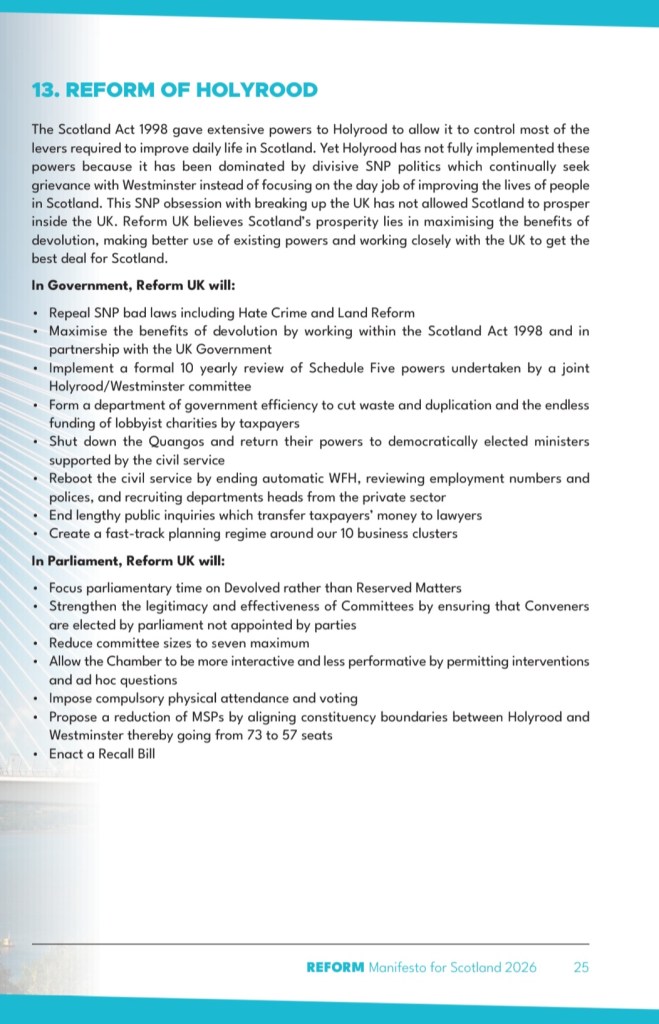
REFORM OF HOLYROOD
In Government, Reform UK will:
The Scotland Act 1998 gave extensive powers to Holyrood to allow it to control most of the levers required to improve daily life in Scotland. Yet Holyrood has not fully implemented these powers because it has been dominated by divisive SNP politics which continually seek grievance with Westminster instead of focusing on the day job of improving the lives of people in Scotland. This SNP obsession with breaking up the UK has not allowed Scotland to prosper inside the UK. Reform UK believes Scotland’s prosperity lies in maximising the benefits of devolution, making better use of existing powers and working closely with the UK to get the best deal for Scotland.
Repeal SNP bad laws including Hate Crime and Land Reform
Maximise the benefits of devolution by working within the Scotland Act 1998 and in partnership with the UK Government
Implement formal 10 yearly review of Schedule Five powers undertaken by a joint Holyrood/Westminster committee Form a department of government efficiency to cut waste and duplication and the endless funding of lobbyist charities by taxpayers
Shut down the Quangos and return their powers to democratically elected ministers supported by the civl service
Reboot the civil service by ending automatic WFH, reviewing employment numbers and polices, and recruiting departments heads from the private sector
End lengthy public inquiries which transfer taxpayers’ money to lawyers
Create a fast-track planning regime around our 10 business clusters
In Parliament, Reform UK will:
Focus parliamentary time on Devolved rather than Reserved Matters
Strengthen the legitimacy and effectiveness of Committees by ensuring that Conveners are elected by parliament not appointed by parties
Reduce committee sizes to seven maximum
Allow the Chamber to be more interactive and less performative by permitting interventions and ad hoc questions
Impose compulsory physical attendance and voting
Propose a reduction of MSPs by aligning constituency boundaries between Holyrood and Westminster thereby going from 73 to 57 seats
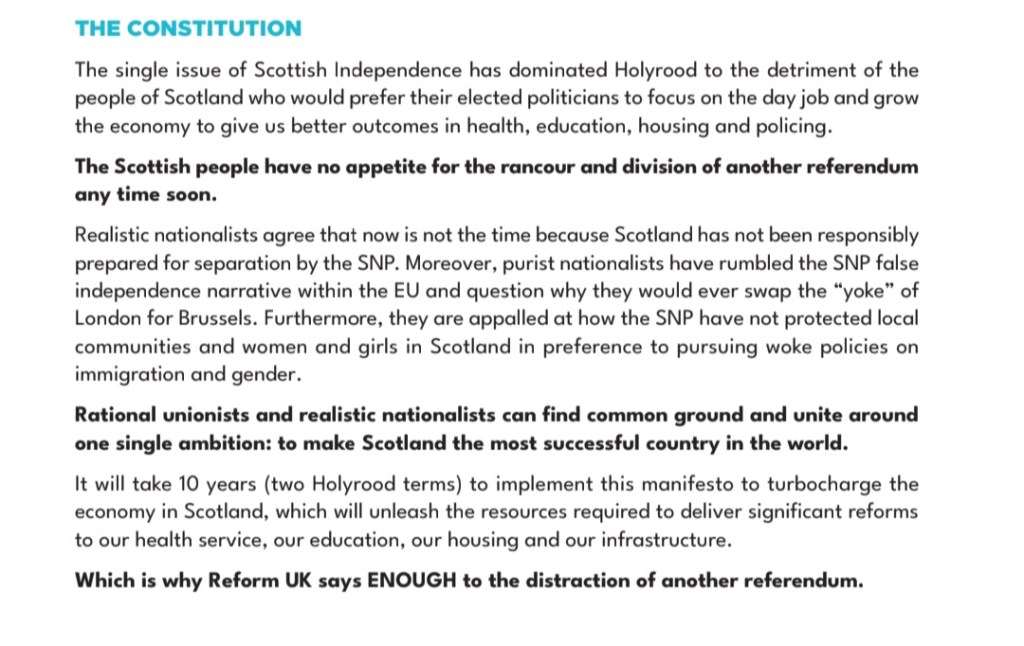
The single issue of Scottish Independence has dominated Holyrood to the detriment of thepeople of Scotland who would prefer their elected politicians to focus on the day job and grow the economy to give us better outcomes in health, education, housing and policing.
The Scottish people have no appetite for the rancour and division of another referendumany time soon.
Realistic nationalists agree that now is not the time because Scotland has not been responsibly prepared for separation by the SNP. Moreover, purist nationalists have rumbled the SNP falseindependence narrative within the EU and question why they would ever swap the “yoke” of London for Brussels. Furthermore, they are appalled at how the SNP have not protected local communities and women and girls in Scotland in preference to pursuing woke policies onimmigration and gender.
Rational unionists and realistic nationalists can find common ground and unite aroundone single ambition: to make Scotland the most successful country in the world.
It will take 10 years (two Holyrood terms) to implement this manifesto to turbocharge theeconomy in Scotland, which will unleash the resources required to deliver significant reformsto our health service, our education, our housing and our infrastructure.Which is why Reform UK says ENOUGH to the distraction of another referendum.
Reform UK is the first of Scotland’s six main parties to launch a manifesto ahead of the Scottish Parliament election on 7 May.
Its recently appointed leader Malcolm Offord, who defected from the Conservatives earlier this year, unveiled the document on Thursday 19 May. The party also revealed its candidates for the election.
The manifesto includes a series of pledges relating to democracy and the constitution. While there are some welcome ideas, notably a recall rule for MSPs, overall the party’s pledges are not right for improving Scottish democracy — and in some cases deeply troubling. Not to mention, there is a considerable lack of detail on numerous pledges and what they will mean in practice.
Here’s what Nigel Farage’s party wants to see on the issue of democracy in Scotland.
1. Reducing the number of MSPs
The manifesto includes a proposal to reduce the number of MSPs by linking Holyrood constituency boundaries with Westminster, which would cut the number of constituency MSPs from 73 to 57 seats. This would leave a total of 113 MSPs if list MSPs were all retained.
While this could arguably increase proportionality at Holyrood by addressing the imbalance of constituency seats to list seats, that is clearly not the purpose here.
Instead, it appears that the intent of this is to weaken Holyrood; the Scottish Parliament has gained significant powers in recent years, and if anything, it should increase its number of MSPs alongside electoral reform to improve proportionality.
The party proposes a recall rule for MSPs, something that has existed in Westminster now for over a decade under a very specific set of circumstances.
A similar process is being established in Wales.
If designed well, a recall rule is welcome. But there is no detail on how such a rule would operate in Malcolm Offord’s manifesto.
3. Cutting Quangos
The manifesto puts the party’s support behind cutting Quangos, with the intention of returning “powers to democratically elected ministers supported by the civl service”.
While there is possibly some potential for valid savings and spending money better elsewhere, the detail of what this would mean is far from clear.
The party says it would focus parliamentary time on devolved rather than reserved matters. While it’s difficult to calculate the exact figures, the vast majority of time spent in the Chamber at Holyrood is certainly focused on devolved matters, and rightly so.
But there’s also a place for focusing some time on reserved issues. It would be an odd spectacle for ministers and MSPs not to address matters of UK-wide and worldwide importance on some level.
The party supports having committee Conveners elected by MSPs rather than appointed by parties and reducing committee sizes to seven.
Ensuring Conveners are elected could strengthen accountability. As for reducing committee sizes, there could be practical benefits of this, however, this would reduce diversity of parties represented on committees. Not to mention this is probably a consequence of the party’s pledge to cut MSP numbers.
The party also pledges to review devolved powers every ten years. This is deeply worrying and adds to concerns from Reform’s plans to cut MSP numbers.
Devolution must be protected and promoted against these threats. The Scottish Parliament has its faults, yes, but those should be fixed to strengthen its foundations rather than exploited to undermine it.
7. No to independence
Lastly, the party has reaffirmed its commitment to the union, stating firm opposition to independence.
What about the other parties?
The SNP, Scottish Labour, Scottish Conservatives, Scottish Greens and Scottish Liberal Democrats are expected to publish their respective manifestos in the coming weeks.
Upgrade Holyrood will publish similar articles in the coming weeks — outlining each party’s stance on democracy.
The 2026 election will be the first Scottish election with restrictions on dual mandates following new regulations after the Scottish Government consulted on the issue in early 2025. The decision followed Stephen Flynn MP’s declaration that he would retain his Westminster role if elected as an MSP in 2026.
Dual mandates have long been a small but persistent problem needing fixed – dual mandate holders cannot effectively represent their constituents due to practical time and location constraints with MSPs and MPs being full-time positions.
The developments following Flynn’s announcement were extremely welcome and spurred the government into action.
New regulations
On 2 September 2025, the Scottish Government introduced three regulations on disqualifying MPs, councillors and members of the House of Lords from the Scottish Parliament.
They were reviewed by the Scottish Parliament, led by the Standards, Procedures and Public Appointments Committee, and approved on 30 October 2025.
The regulations took effect on 31 October 2025, but the new limits on dual mandates will only apply to MSPs from the next Scottish Parliament election on Thursday 7 May 2026.
However, there is also a grace period – this time much shorter – of 14 days, during which a peer elected to Holyrood or vice versa must step down from one of their roles.
If an MSP becomes a councillor, they can stay as an MSP for 49 days. But if a councillor becomes an MSP, they can stay as an MSP either until the next council election if it’s within 372 days, or for 49 days if the election is further away.
In practice, this means that any councillors elected at the May 2026 election can retain their council role until local authority elections in May 2027.
The dual mandate bans are a welcome addition to Scotland’s democracy, ensuring that constituents can be effectively represented at multiple layers of government.
Grace periods are a sensible solution to allow for adjustments, and while the extended councillor-MSP grace period is a practical addition to limited impacts on local government, this should be monitored to see how effective it really is.






 Upgrade Holyrood
